
Future Automation is a British engineering firm that has made motorised TV lifts, projector lifts, hinges and sliding panels since 1998, all built to order. Having fitted one in Esher, our honest review is that the engineering and finish are excellent, but it needs ceiling depth, early joinery decisions and careful programming, and its TV lifts are not silent.
Last reviewed: 18 October 2026
This is the installer’s view. For how we specify and fit the range, see our Future Automation lifts and concealment page.
Who are Future Automation?
The company says it has designed and manufactured mechanisms for homes, commercial buildings and boats since 1998, and on its home page it calls itself an engineering business based in Britain and North America. Its Made in Britain member listing gives an address in Bedford and shows it joined that scheme in August 2015. Future Automation doesn’t publish who owns it, and we haven’t found a reliable public source that does, so we won’t guess.
Design and manufacture are kept in-house, each motorised mechanism is made to order rather than taken from stock, and every unit is assembled and tested by hand. A 2021 StereoNET profile adds that its products go into superyachts and high-end offices as well as homes, which explains the marine-rated versions in the catalogue.
What is Future Automation known for?
Making screens disappear. The catalogue runs to more than 300 products, but they come down to a handful of ideas built in many sizes: lifts that raise a TV out of a cabinet, hinges that fold one down from a ceiling, panels that slide across a screen, and lifts that lower a projector out of a void. When we checked the projector lift range on 14 October 2026, it listed the PDR-RES for plastered home ceilings, versions made for Sony and Barco projectors, marine and outdoor models, and the PH hinge, which tucks a projector into a wall where there is no room above the ceiling.
Among installers, the brand is also known for thinking about the trades around it. On the PDR-RES, the frame goes in early and the plasterer works up to it, so the mechanism itself arrives clean at the end of the job and the closed lid can be painted out to match the ceiling (PDR-RES specification, checked 14 October 2026).
Why do clients choose Future Automation?
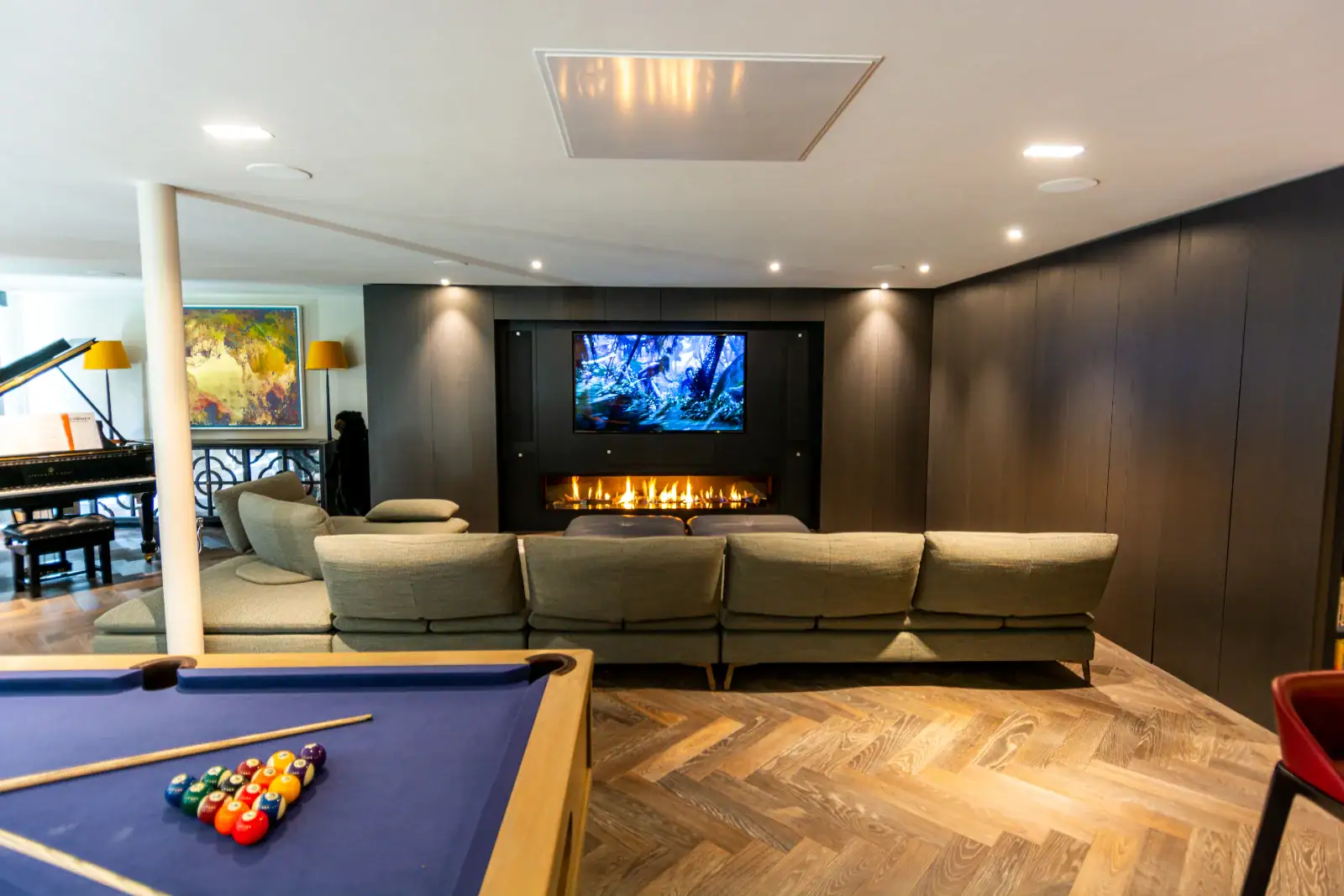
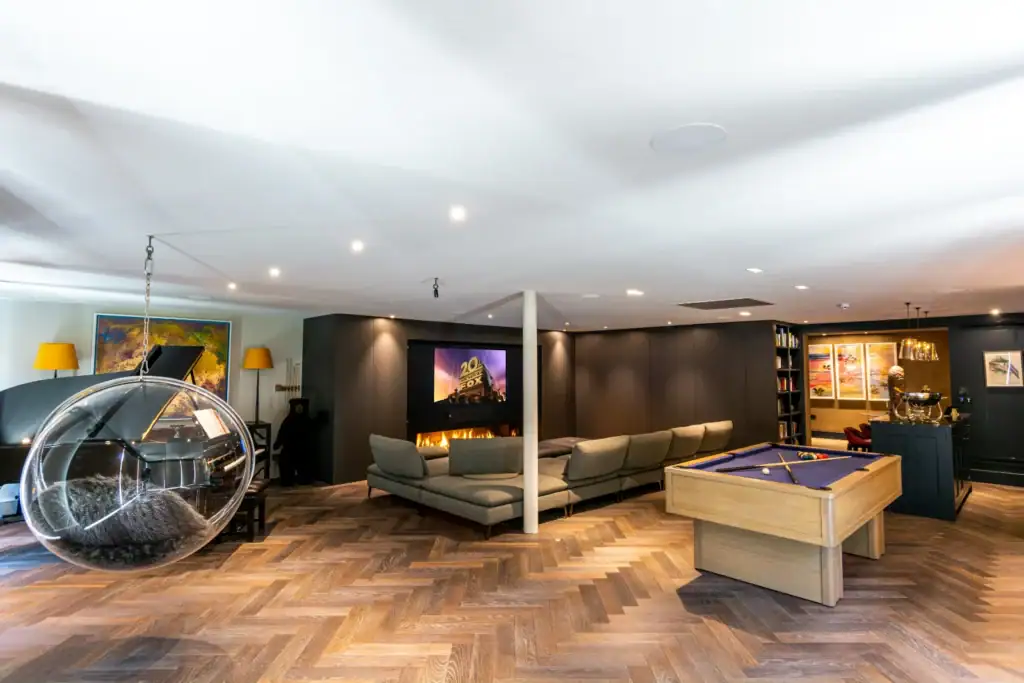
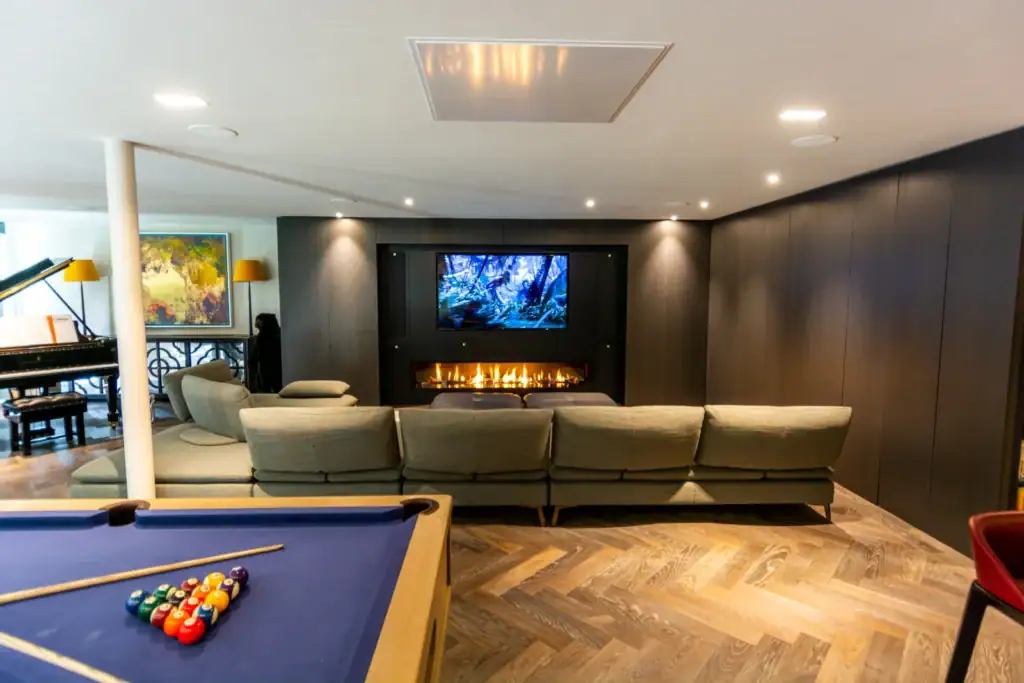
Usually because someone has said that no technology can be on show. That was the brief for our Esher entertainment and cinema room, an open-plan space with a bar, a pool table and a lounge area. An 85 inch Samsung TV handles everyday viewing. For a film, a Future Automation lift lowers the projector from the ceiling while a 120 inch Draper screen comes down in front of the TV, and afterwards both go back out of sight. The family switch between the two with one touch.
The second reason is flexibility. Because each mechanism is built to order, the company can adjust sizes and finishes, and it runs a bespoke design service for rooms that no catalogue item fits. StereoNET adds that frames are powder coated and can be colour matched.
What are the pros and cons of Future Automation?
This is how it balances out on the jobs we see. The cons come from the maker’s own specifications, all checked on 14 October 2026.
Pros
- Built to order and hand tested, with a bespoke service for awkward rooms.
- A wide range, including a wall hinge for ceilings too shallow for a lift.
- Plain wired control. The LSM TV lift and the PDR-RES projector lift both accept RS-232, contact closure and IR (checked 14 October 2026), so almost any control system can drive them.
- Neat finishing, with plaster-in frames and paintable lids that close almost flush.
Cons
- It needs space. The larger PDR3-RES needs 295 mm of clear void, lifts 45 kg at most and takes a projector up to 560 by 650 mm (checked 14 October 2026). Bigger Sony and Barco models need the custom versions.
- It is not silent. The LSM TV lift is rated at 52 dB (checked 14 October 2026). That is fine in a family room, but you will hear it in a quiet bedroom.
- TV upgrades are limited. Each LSM variant is sized for a band of screens with a 50 kg lifting limit, so a much bigger TV later can mean a new mechanism, such as the heavy-duty LSH (checked 14 October 2026), and new joinery.
- No published Control4 driver. Future Automation’s site doesn’t mention Control4, so the installer has to programme and test the serial, contact or IR commands. We didn’t find position feedback in the specifications we read.
- Warranty terms aren’t on the website. The About page promises a manufacturer warranty but gives no length.
- It has to be planned in. Made to order means it isn’t a stock item you can buy the week before the decorators finish.
Who does Future Automation suit, and who does it not?
It suits rooms with more than one job: a lounge that becomes a cinema, a drawing room where the interior designer has ruled out a black rectangle on the wall, or a principal bedroom where the TV should rise from the foot of the bed. It suits new builds and full refurbishments best, because the ceiling void, the joinery and the cable routes can all be drawn around the mechanism before anything is built. Our media room service is where most of these projects start.
It suits less well in a finished room where nobody wants the ceiling opened, for owners who like to change TV size every few years, or on a programme too tight to wait for a made-to-order mechanism. Our guide to choosing a projector or a TV is a good first step.
How does Future Automation fit a Control4 and Lutron home?
Comfortably, as long as it is planned rather than bolted on. The mechanisms understand simple wired commands, and Control4’s CORE 5, still on its current controller list when we checked on 14 October 2026, has eight IR outputs, four serial outputs, four contact inputs and four relays, according to its data sheet. We then write the lift into the room’s scenes and test the order of events until it is foolproof, for example making sure the projector has gone to standby before it rises back into the ceiling.
Future Automation makes no claims about Lutron, and none are needed. Most of our projects pair Lutron lighting with Control4 automation, with Control4 acting as the go-between, so one Cinema button can set the Lutron lighting scene, lower the projector and bring down the screen. Esher itself runs its lighting through Control4 rather than Lutron, which shows the mechanism doesn’t mind which lighting system it sits beside. For homes that want Lutron, our Lutron lighting control page explains how we design the two together.
If you are thinking about hiding a TV or projector, get in touch or book a visit to our Walton-on-Thames showroom, by appointment, to talk the room through.
Frequently asked questions
How noisy is a Future Automation TV lift?
Future Automation rates its LSM cabinet lift at 52 dB (checked 14 October 2026). In a busy family room you will barely notice it, but in a silent bedroom late at night you will hear it moving. We factor that into where the cabinet goes.
Does Future Automation make lifts for boats?
Yes. Its projector lift range includes marine and outdoor marine models, and the LSM TV lift carries a marine rating, with a lower 30 kg lifting limit in that use (checked 14 October 2026). StereoNET’s 2021 profile also mentions work on superyachts.
What warranty does Future Automation give?
The company says it gives a manufacturer warranty on all its mechanisms, but its About page doesn’t state the length or the terms. Ask for the written terms before you order and keep them with the handover documents.
Can I fit a bigger TV to my lift later?
Sometimes, but not always. Each LSM variant covers a band of screen sizes, about 32 to 60 inches across the range, with a 50 kg lifting limit, and the cabinet’s internal height is set to match (checked 14 October 2026). A much larger TV usually means a different mechanism and new joinery, so check the new screen’s height and weight before you buy it.