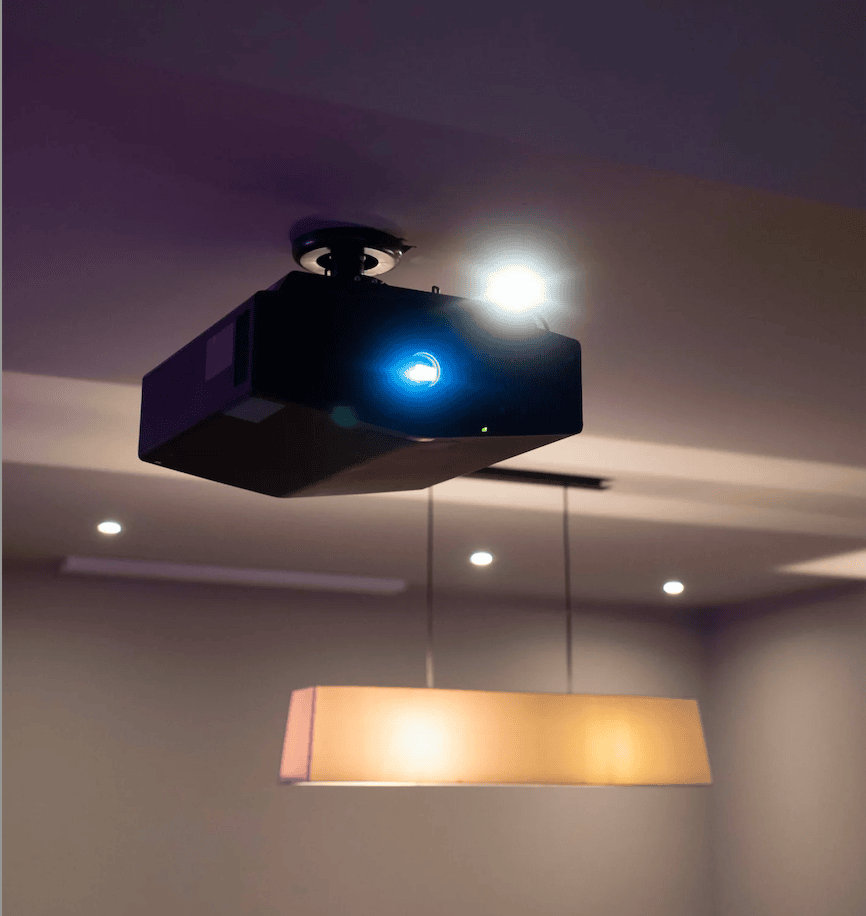
Choose a TV if your room has daylight you cannot fully control, or if a screen of up to about 100 inches is big enough. Choose a projector if you can make the room properly dark and want a bigger picture: in the dedicated cinemas we build, that usually means 120 inches or more. Some rooms have both.
What is the real difference between a projector and a TV?
A TV makes its own light. A projector throws light onto a screen, and what you see is the light the screen reflects back. That one difference drives almost everything else.
Even the numbers are different. Projector output is quoted in lumens, the total amount of light the projector produces. The brightness you actually see on a screen or a TV is measured in nits, which is candela per square metre. BenQ’s guide to brightness units makes the key point: because a projector’s light spreads across the screen, the size of the screen affects how bright the final picture is.
So light in the room matters far more to a projector. Ambient light, the light that fills a room from windows and lamps, lands on the screen too and washes the picture out. A TV fights it with its own brightness. A projector needs the room to help.
How big can a TV get now?
Bigger than most people expect. LG lists a 97 inch OLED TV on its UK site, and when we checked on 25 September 2026, Richer Sounds was taking pre-orders for Hisense’s 116 inch TV at £17,999.
In smaller rooms with some daylight, we usually recommend a 75 or 85 inch 4K OLED TV instead of a projector: the picture is brighter, the contrast holds up better in real-world conditions, and the installation is simpler. Our small cinema room guide explains that choice for rooms of 12 to 16 square metres.

A TV can still be the heart of a serious room. Our Epsom media room was built around a recessed 85 inch Sony TV, an Anthem MRX740 receiver with 5.1 surround sound, acoustic panelling and automated blackout blinds, for a family who watch football, films and games in the same space.
How do you read projector brightness figures?
Carefully. Epson, whose projectors we used in our Oxshott and Weybridge cinemas, advises looking for two figures: white brightness measured to the ISO 21118 standard, and colour brightness measured to IDMS 15.4. Epson warns that on some projectors the real colour brightness can be as little as a third of the lumens stated. A big lumens number with no standard beside it tells you very little.
For a sense of scale, our Oxshott cinema uses an Epson LS12000 laser projector. Epson rates the UK model, the EH-LS12000B, at 2,700 lumens for both white brightness (ISO 21118:2020) and colour brightness (IDMS 15.4), with a laser light source rated for up to 20,000 hours.
Does your room decide for you?
Often, yes. Three things settle most of our projector conversations.
- Light control. If the room can be properly darkened, with blackout blinds, no awkward windows and a door you can close, a projector makes sense. If not, a TV will usually give you the better picture. Basements have a head start here; see our guide to building a cinema room in a basement.
- Throw distance. Every projector lens has a throw ratio: the distance from projector to screen divided by the width of the picture, as BenQ explains. Epson quotes 1.35 to 2.84:1 for the EH-LS12000B, so for a 120 inch 16:9 picture, about 2.66 metres wide, it can sit anywhere from roughly 3.6 to 7.5 metres from the screen (our arithmetic from Epson’s figures).
- Ceiling and seats. The projector has to sit where it clears heads and suits the lens. In Oxshott the sloped ceiling constrained where the projector and speakers could go, so we designed the layout around the ceiling line.

What does a projector let you do that a TV cannot?
Put the speakers where the film expects them. An acoustically transparent screen is a woven or perforated screen that lets sound pass through, so the left, centre and right speakers can sit behind the picture. Stewart Filmscreen explains why that matters: soundtracks are mixed to come from the screen, and speakers behind it line the sound up with the action. A TV panel is solid, so its speakers have to go beside, above or below it.
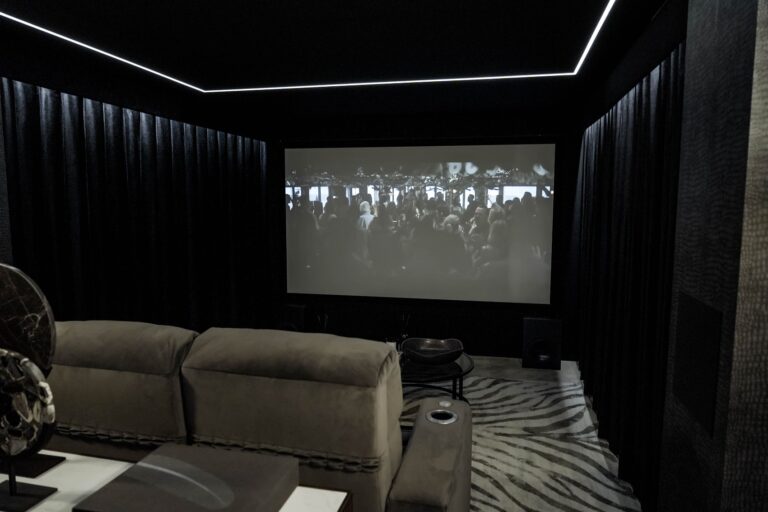
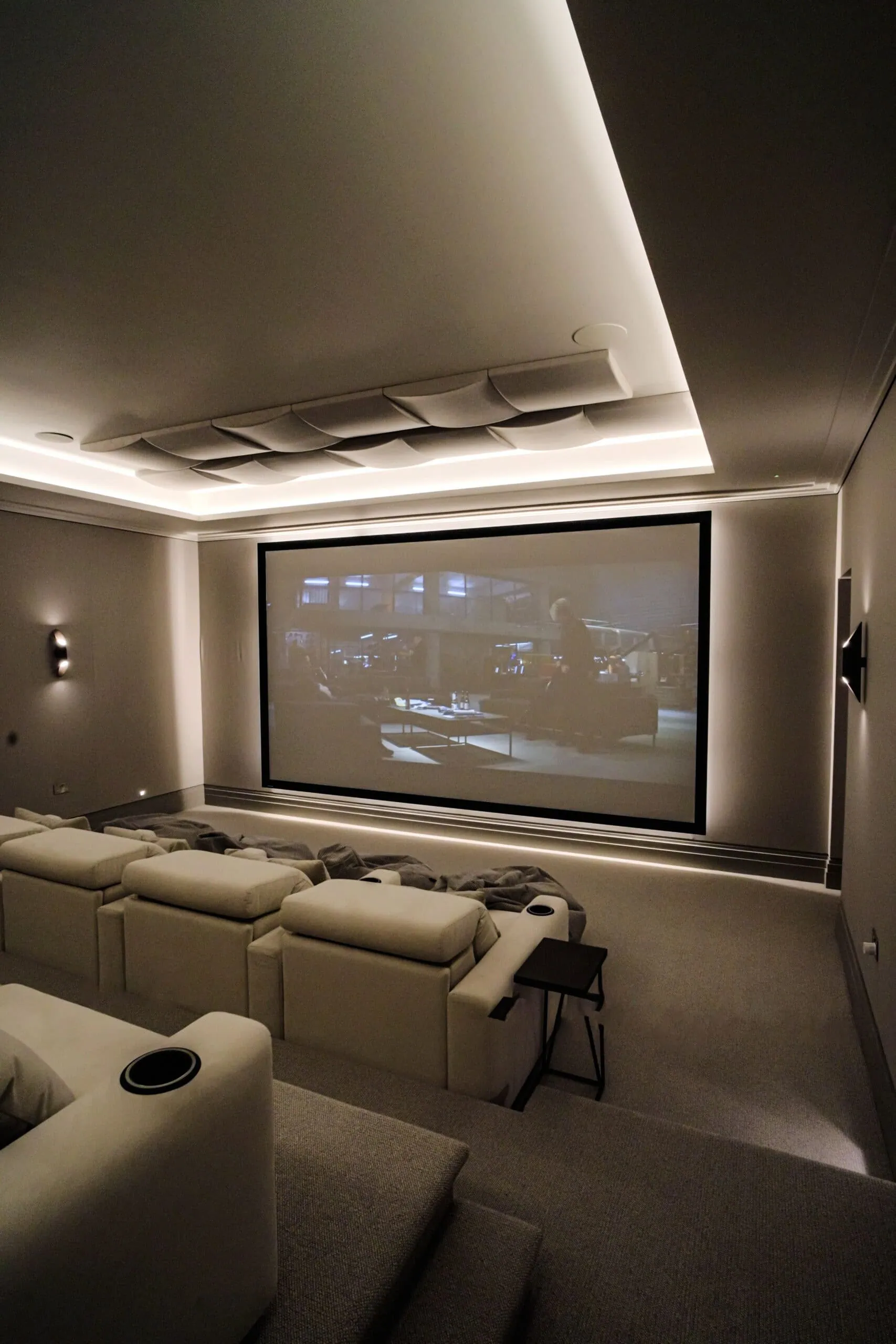
That is how our Oxshott cinema works: a 120 inch acoustically transparent fixed-frame screen with a KEF THX 7.2.2 Dolby Atmos system behind and around it. In our Weybridge basement cinema, KEF Ci4100 in-wall speakers sit behind a 126 inch Projecta acoustically transparent screen.
Then there is size. The largest TV we found on sale in the UK was 116 inches, while the cinema screens in our published projects run to 120 and 126 inches, and the one in our showroom is 2.8 metres wide.
Can you have both a TV and a projector?
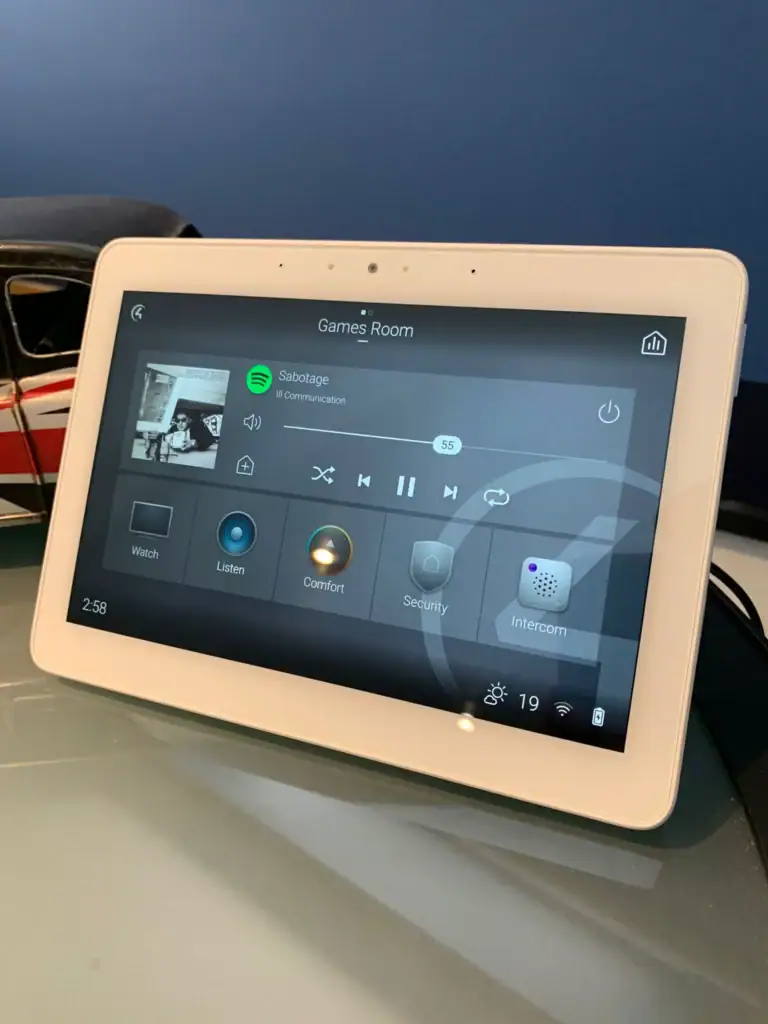
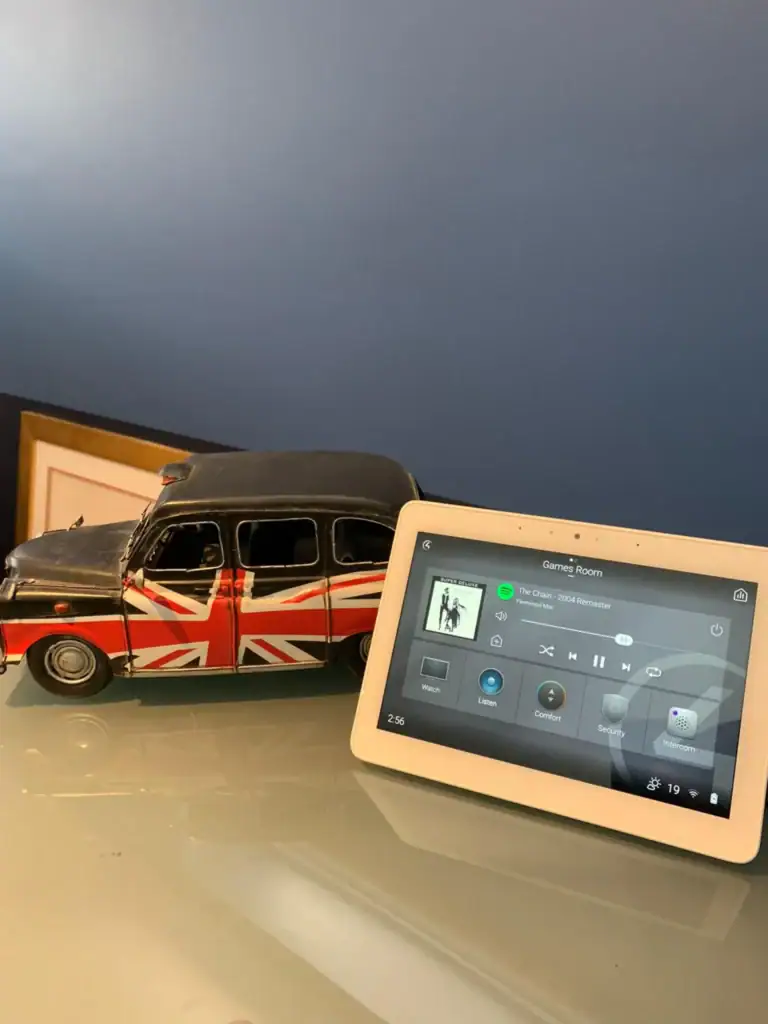
Yes, and in rooms that have to do two jobs it is often the right answer. In our Esher entertainment room, an 85 inch Samsung TV handles everyday viewing. For film night, a concealed projector lowers from the ceiling and a Draper motorised 120 inch screen drops in front of the TV, at one touch on the Control4 system. When it is not film time, both disappear.
If the room has to stay a living space, our media rooms page covers that decision in more detail.
So which should you choose?
- Choose a TV if the room has daylight you cannot fully block, if it is a family room first, or if 75 to 97 inches is the size your seating distance calls for.
- Choose a projector if you can control the light, you want a picture larger than a TV offers, and you want the front speakers hidden behind the screen.
- Choose both if the room is a lounge by day and a cinema by night.
Whichever way you go, the screen size should come from where you sit, not the other way round. Our guide to home cinema screen size and viewing distance shows how to work it out, and our luxury home cinema service covers the whole room, from design and 3D visuals through to installation and calibration.
The quickest way to decide is to see a projector at full size. Our Walton-on-Thames demonstration cinema runs a Sony 4K laser projector on a 2.8 metre wide acoustically transparent screen with a Lyngdorf 7.2.2 sound system. Book a showroom visit and bring a film you know well.
Frequently asked questions
Is a projector better than a TV for a home cinema?
A projector is better when you can make the room dark and want a picture bigger than a TV can give; a TV is better when daylight or lamps are part of how the room is used. In a dedicated, darkened cinema room we usually recommend a projector with an acoustically transparent screen.
How many lumens does a home cinema projector need?
Epson suggests a minimum of 1,500 lumens for a home cinema projector in a room where ambient light is kept to a minimum. The right figure also depends on screen size and screen material, so compare white and colour brightness measured to ISO 21118 and IDMS 15.4 rather than one headline number.
What is the biggest TV you can buy in the UK?
The largest we found on sale in the UK on 25 September 2026 was Hisense’s 116 inch TV, listed for pre-order by Richer Sounds. LG lists a 97 inch OLED on its UK site.
Can I use a projector in a room with windows?
Yes, if the windows can be fully blacked out when you watch. Automated blackout blinds on the same control system as the lights, like the QMotion blinds in our Epsom media room, turn that into one button.
Does a projector need a special screen?
Yes, it needs a proper screen, and the choice matters. The screen surface should suit the projector’s brightness, and an acoustically transparent screen lets the front speakers sit behind the picture.