
KEF speakers are worth their reputation. The British company’s Uni-Q driver gives an unusually even sound across a room, its in-wall and in-ceiling range is broad, and build quality is consistent. The catches are practical: the larger architectural models need deep ceiling voids and capable amplification, and the hi-fi models want space and well-matched electronics.
Last reviewed: 25 October 2026
We have specified KEF in several of our cinema rooms, so this KEF speakers review is not a neutral desk review. It is what I tell clients when they ask whether the name on the grille deserves the money. If you want to see the rooms themselves, our KEF cinema projects and speaker range overview covers them. This piece is about the company, its strengths and its weak spots.
Where does KEF come from, and who owns it today?
Raymond Cooke, an engineer who had worked at the BBC, started KEF in 1961. The name comes from Kent Engineering and Foundry, and the company began life in a Nissen hut on that firm’s site in Maidstone. KEF’s own history page tells the story and dates its first product, the compact Celeste, to 1962.
The decades that followed built the reputation. KEF drivers sat inside the LS3/5a, the small monitor designed at the BBC and dated by KEF’s timeline to 1975. In 1988 the company patented Uni-Q, which it calls the first truly coincident source driver. By 1994 it had produced one of the first home theatre systems to meet the THX standard. Cooke died in 1995.
Ownership changed in 1992, when Hong Kong’s Gold Peak group bought the company and placed it under its GP Acoustics business, as KEF’s Wikipedia entry records. Gold Peak still lists KEF among its brands today, and KEF continues to describe the UK as its home. Engineering continuity matters more: the Ci250RRM-THX in-ceiling speaker, which KEF calls its first architectural speaker with MAT, uses a twelfth-generation Uni-Q array (checked 14 October 2026).
What is KEF best known for?
Uni-Q, first and last. On a conventional speaker the tweeter and woofer sit at different heights, so the balance shifts as you move around. Uni-Q nests the tweeter inside the woofer, and KEF says on its custom installation collection page that the result gets rid of the limited sweet spot. In practice the person at the end of the sofa hears much the same balance as the person in the middle, which is the whole game in a family cinema.
The second thing is breadth. KEF’s UK architectural range (checked 14 October 2026) runs from the Ci-T Series, which needs only 36mm of mounting depth, through Q Series, R Series and Reference models with THX versions, to the Ventura outdoor range rated IP65 and a THX system it calls Extreme Home Theatre. Few makers cover a shallow kitchen ceiling, a dedicated cinema and a garden with one family of drivers.
Third, the hi-fi side keeps the engineering honest. KEF’s Metamaterial Absorption Technology, which absorbs unwanted sound from the rear of a driver, was named Innovation of the Year at the What Hi-Fi? Awards in 2020, according to KEF, and the LS50 launched in 2012 to mark the company’s 50th anniversary. That research ends up in the ceiling speakers too.
Why do our clients choose KEF?
In our projects the speakers are rarely the visible part of the room, and that is usually the point. The reasons come up again and again.
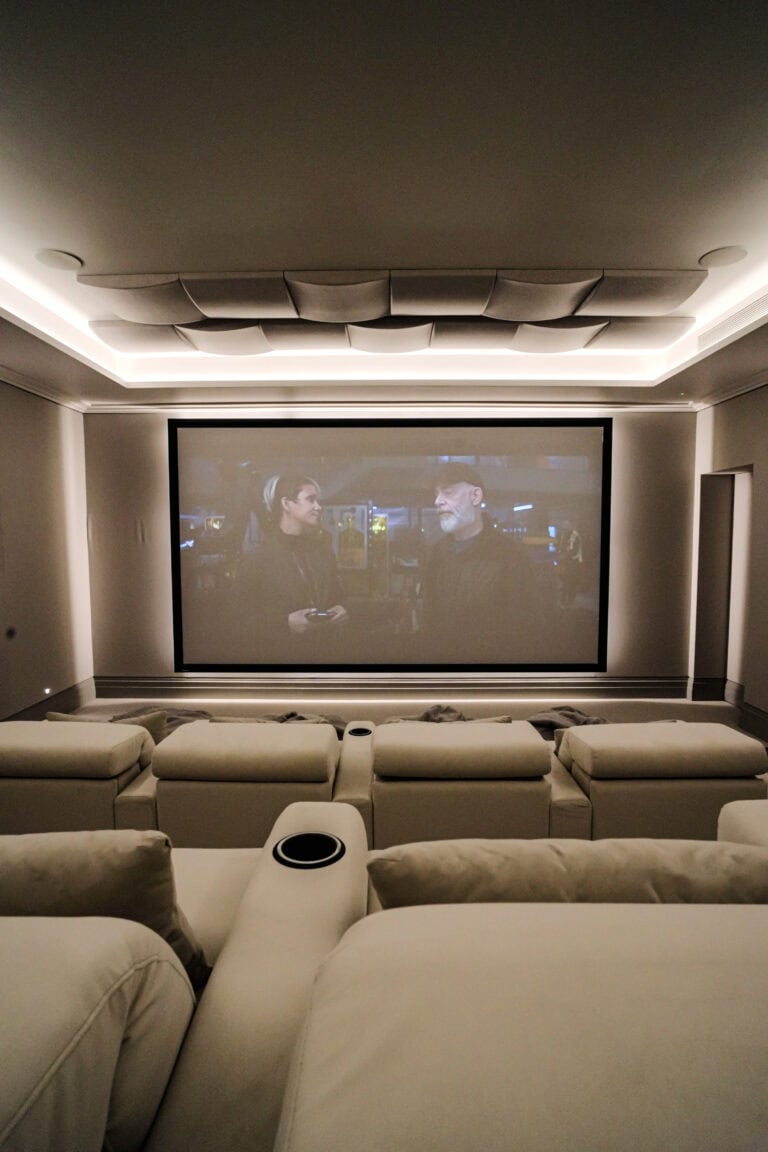
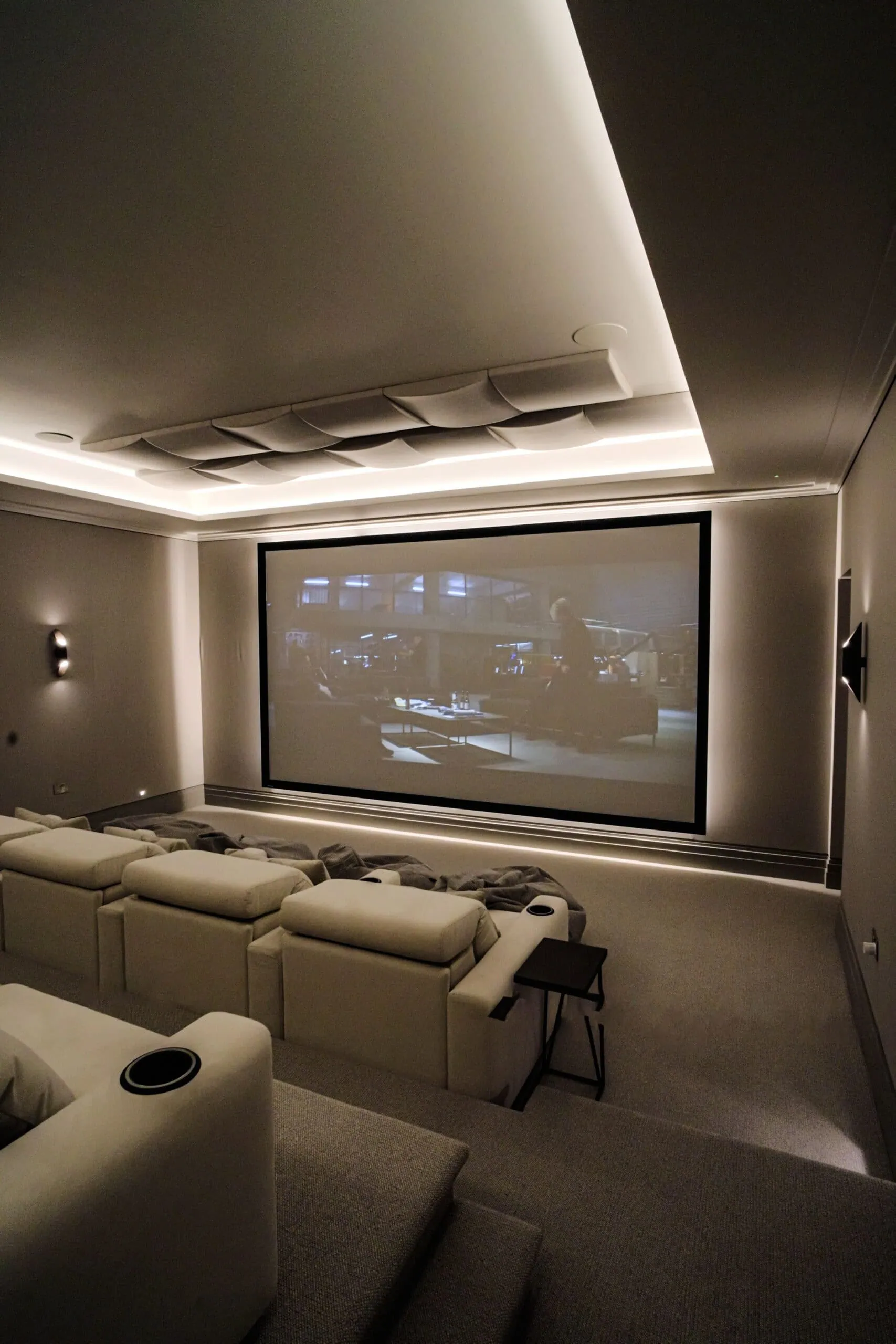
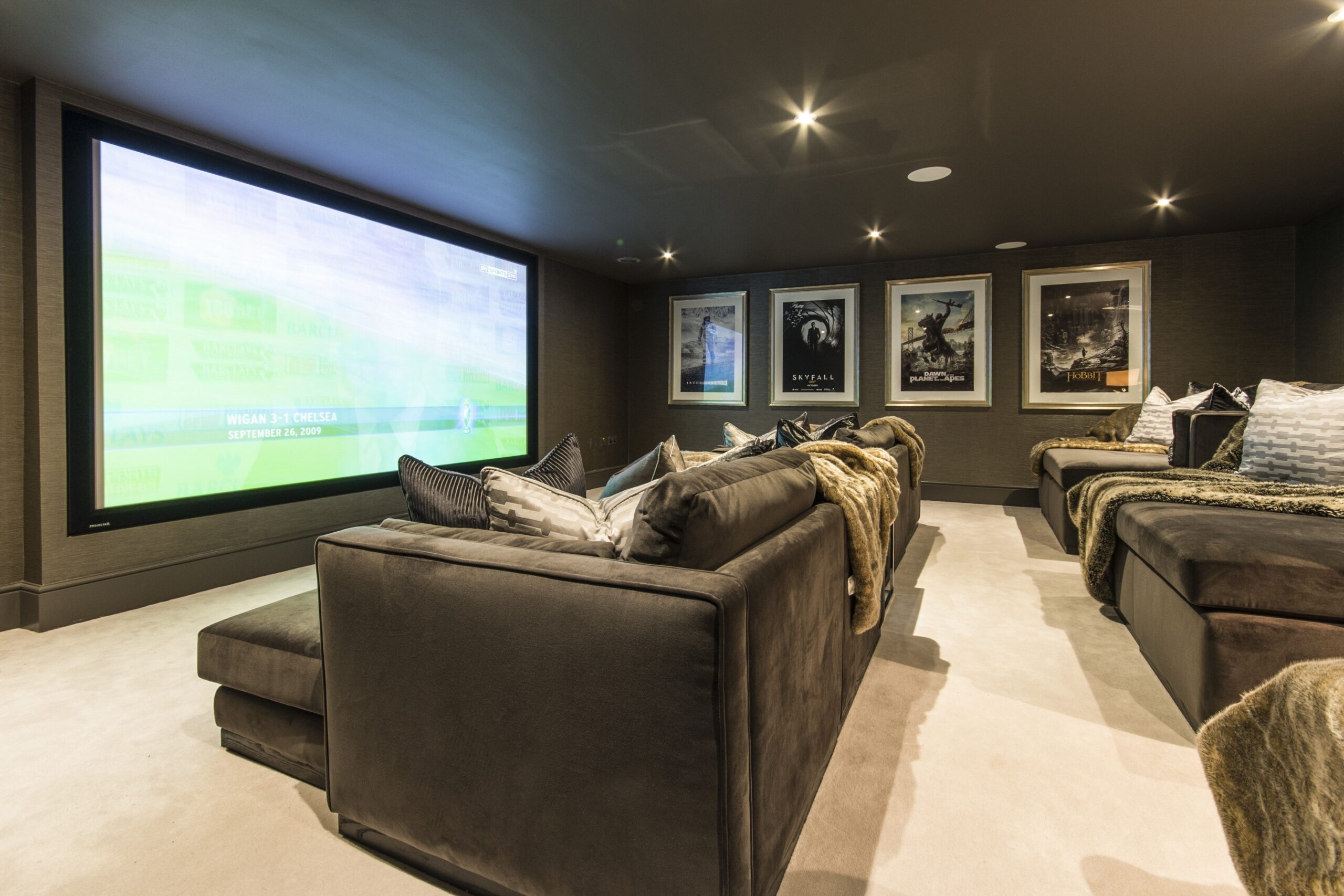
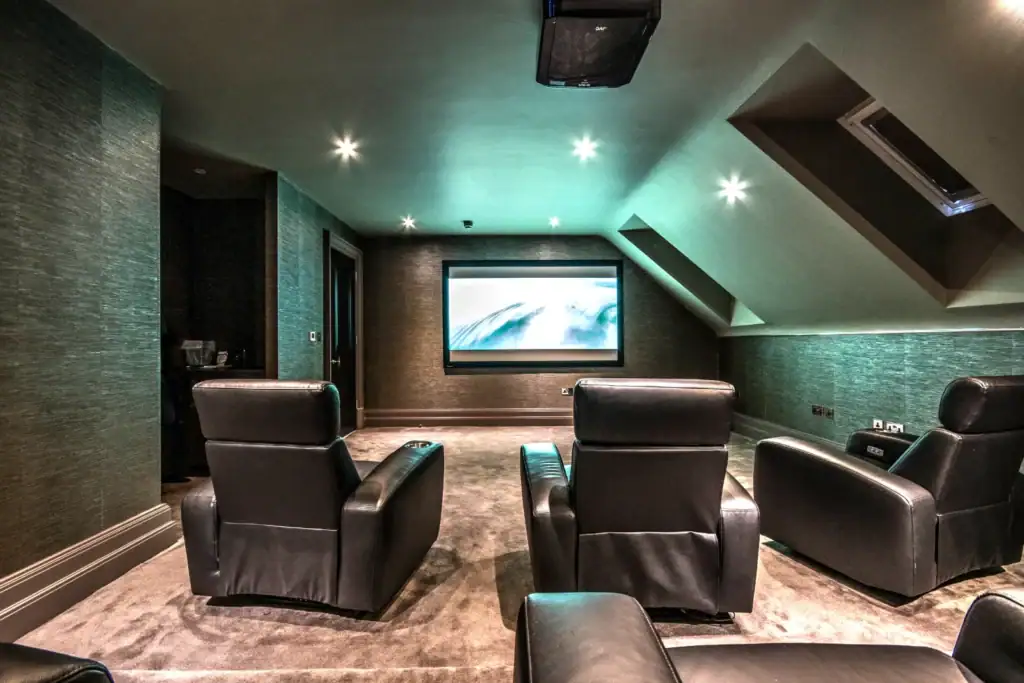
- The room stays clean. In our Oxshott cinema the front speakers sit behind a 120-inch acoustically transparent screen, with a KEF THX 7.2.2 Dolby Atmos package filling the rest of the room. In Weybridge, in-wall and in-ceiling KEF models kept a family basement free of boxes.
- Sound that suits awkward rooms. The Oxshott room has a sloped ceiling that limited where speakers could go, while Esher puts the cinema, a bar and a snooker table in one open room. Even dispersion matters more in rooms like these than in a perfect box.
- A matched set. In Weybridge the front, surround, ceiling and subwoofer channels all come from KEF’s Ci range, so voices and effects keep the same character as they move around the room.
If you are still deciding how many channels a room needs, our guide to Dolby Atmos speaker layouts is the better starting point. The brand comes after the layout.
What are the pros and cons of KEF speakers?
Here is my honest list, with the sources behind the points that are not just my opinion.
Pros
- Even coverage across several seats, thanks to the coincident Uni-Q design.
- One of the widest architectural ranges available, from shallow ceilings to THX cinema models and outdoor speakers.
- A long home cinema record, with THX systems going back to 1994.
- Strong independent reviews. What Hi-Fi’s guide to KEF speakers, updated in May 2026, praises the LS50 Meta and R3 Meta for transparency and refinement; both are listed on KEF’s UK site (checked 14 October 2026).
Cons
- The larger THX models need space. KEF’s specification for the Ci250RRM-THX gives a 168mm mounting depth, an ideal rear volume of 150 litres (80 litres at minimum) and a recommended amplifier power of 50 to 250W (checked 14 October 2026). Plenty of ceilings cannot offer that without a back box or building work.
- The hi-fi models are fussy about placement. The same What Hi-Fi guide warns against putting the LS50 Meta on a bookshelf or against a wall, and says the R3 Meta sounds best away from a wall and with equally capable electronics (both checked 14 October 2026).
- Competition is stiff lower down. What Hi-Fi lists strong rivals as a drawback of the entry Q3 Meta, which is still on KEF’s UK site (checked 14 October 2026).
Who are KEF speakers right for, and who should look elsewhere?
KEF suits people who watch with others. If your cinema or media room has a second row, or a sofa that runs wide of the screen, the even coverage pays off. It also suits anyone who wants one maker across the house: a cinema, ceiling speakers in the kitchen and something weatherproof on the terrace can all come from one range, which keeps the sound character familiar from room to room.
It is a weaker fit in three cases. If you want no grille at all, plaster-over invisible speakers are a different category, and KEF is not where I would start. If your ceiling void is shallow and you want top-tier performance, the physics of the bigger models will fight you. And if you want a self-contained system you set up from a phone, KEF’s architectural speakers are passive and need an amplifier or AV receiver, so they belong in an installed design rather than a box from a shop.
How does KEF fit a Control4 and Lutron home?
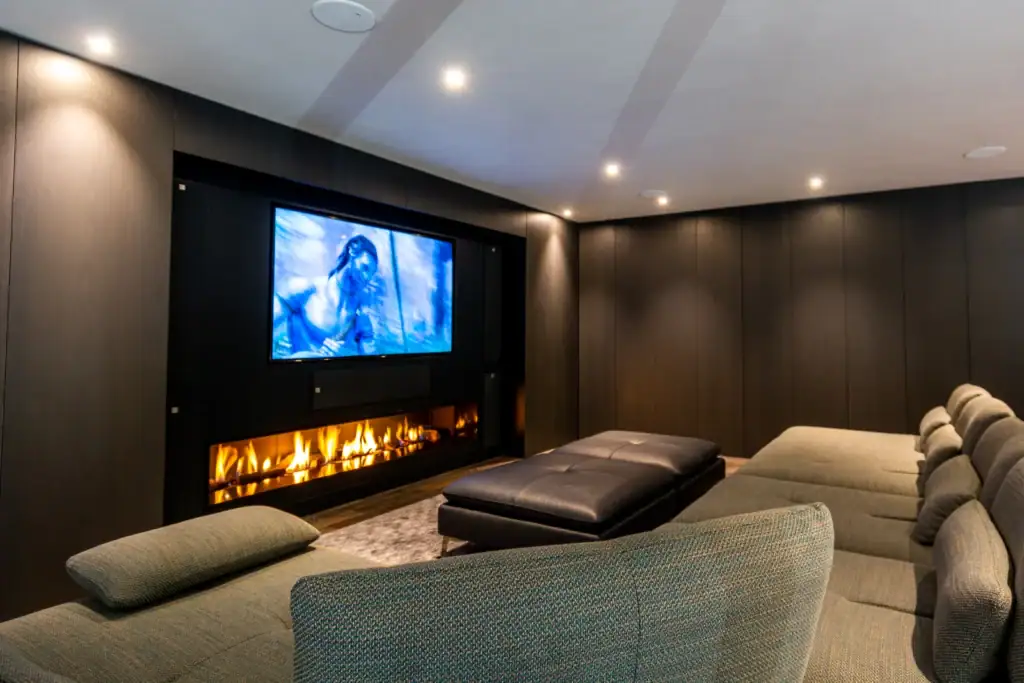
KEF does not talk to Control4 or Lutron directly, and it does not need to. The speakers are driven by the AV receiver or processor (a Denon in Oxshott and Weybridge, Marantz electronics in Esher), and that is what Control4 controls, along with the sources, the screen and the projector.
The useful part is the scene. In Oxshott we programmed separate Control4 modes for film and for sport, so the lights, the picture and the sound change together. A Lutron home works the same way: Lutron lighting control handles the dimming and Control4 calls the scene. As a Platinum Control4 dealer we design those links at the same time as the speaker layout, which is how the cinema rooms on our home cinema design and installation page are planned.
Frequently asked questions
Who owns KEF?
KEF has belonged to the Hong Kong-based Gold Peak group since 1992, through its GP Acoustics business, and Gold Peak lists KEF among its brands today. The company was founded in Maidstone, Kent, in 1961 and still describes the UK as its home.
Are KEF speakers as good for music as they are for films?
Yes. KEF’s reputation was built on hi-fi, and the Uni-Q driver in its architectural models shares that lineage. In a cinema room the same speakers that handle a film soundtrack will play music well, provided the amplification and room correction are set up properly.
Do KEF architectural speakers need a separate amplifier?
Yes. They are passive, so they need an AV receiver, processor and power amplifier, or a multi-room amplifier. KEF publishes a recommended power range for each model, and we match the electronics to it at the design stage.
Can I hear KEF speakers at your showroom?
Not at the moment. Our demonstration cinema runs a Lyngdorf Audio system, so for KEF we talk you through our finished projects instead. A visit to our Surrey showroom is still the best way to judge layout, screen size and seating, and you can contact us to arrange it.