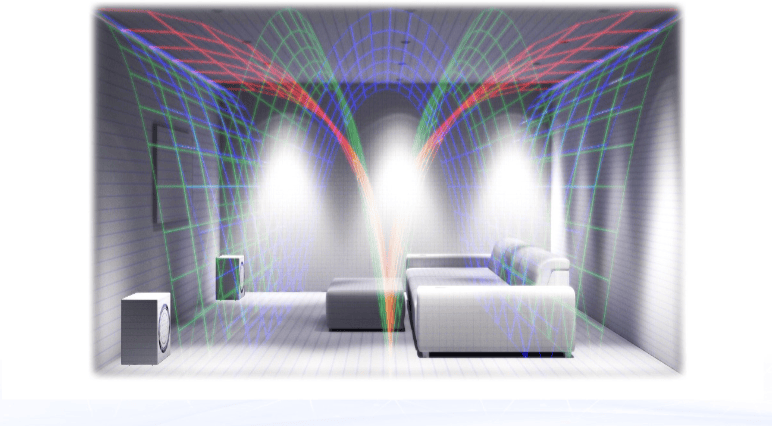
A Dolby Atmos speaker layout is written as three numbers. The first is the speakers around you at ear level, the second is the subwoofers and the third is the overhead speakers. So 5.1.2 means five ear-level speakers, one subwoofer and two overhead; 7.1.4 is seven, one and four; 9.2.6 is nine, two and six.
What do the three numbers in a Dolby Atmos layout mean?
Dolby’s speaker setup guide defines them. The first number is the standard ear-level speakers: left, right and centre, plus the surrounds. The second number, after the dot, is the subwoofers, the speakers dedicated to bass. The third number, if there is one, is the height speakers for Dolby Atmos.
Three details from Dolby’s home cinema installation guidelines are worth knowing before you choose:
- Dolby Atmos produces a single low-frequency effects (LFE) signal. A second or fourth subwoofer is there to make bass even across the seats, not to carry a separate channel.
- Apart from the centre speaker and the centre surround (a single speaker directly behind the seats), speakers are always added in pairs.
- A home Dolby Atmos system can support up to 34 speaker positions, for example 24.1.10.
What does a 5.1.2 layout include?
Left, centre and right speakers at the front, a pair of surrounds, one subwoofer, and two overhead speakers that Dolby calls the top middle pair, in the ceiling over the seating area (Dolby’s 5.1.2 guide).
It is a sensible start in a smaller room. Our small cinema room guide is built around 5.1 or 5.1.2 systems, and makes the point that in a room of 12 to 16 square metres an eleven-channel Atmos array rarely earns its cost: there is not the volume of room for the extra channels to deliver.
What does 7.1.4 add?
Two more ear-level speakers behind the seats, called rear surrounds, and a second pair of ceiling speakers, so the overhead speakers become a top front pair and a top rear pair (Dolby’s 7.1.4 guide). With four overhead speakers, sound can travel from front to back across the ceiling rather than simply appearing above you. For professional mixing rooms, Dolby’s support team calls 7.1.4 the preferred minimum.
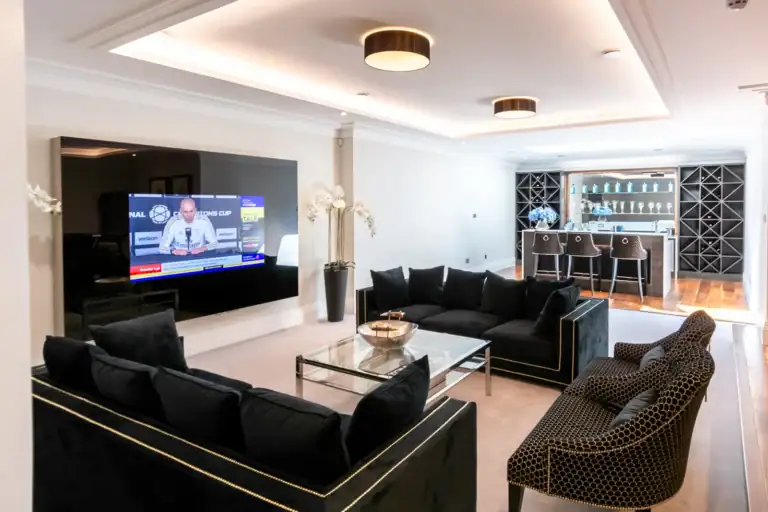
Our Walton-on-Thames media room renovation runs a 7.2.4 Dolby Atmos layout on Paradigm Pro Series speakers with Paradigm Seismic 110 subwoofers. Not every room needs four overhead speakers, though: our Oxshott cinema and our showroom cinema both run 7.2.2, which is seven ear-level speakers, two subwoofers and two overhead.

What is 9.1.6, or 9.2.6?
Nine ear-level speakers adds a pair of wides, between the front speakers and the surrounds. Six overhead speakers gives top front, top middle and top rear pairs (Dolby’s 9.1.6 guide). Write it as 9.2.6 and you have the same layout with two subwoofers. It suits bigger rooms with more than one row, where extra positions let sound pan smoothly around a wider audience.
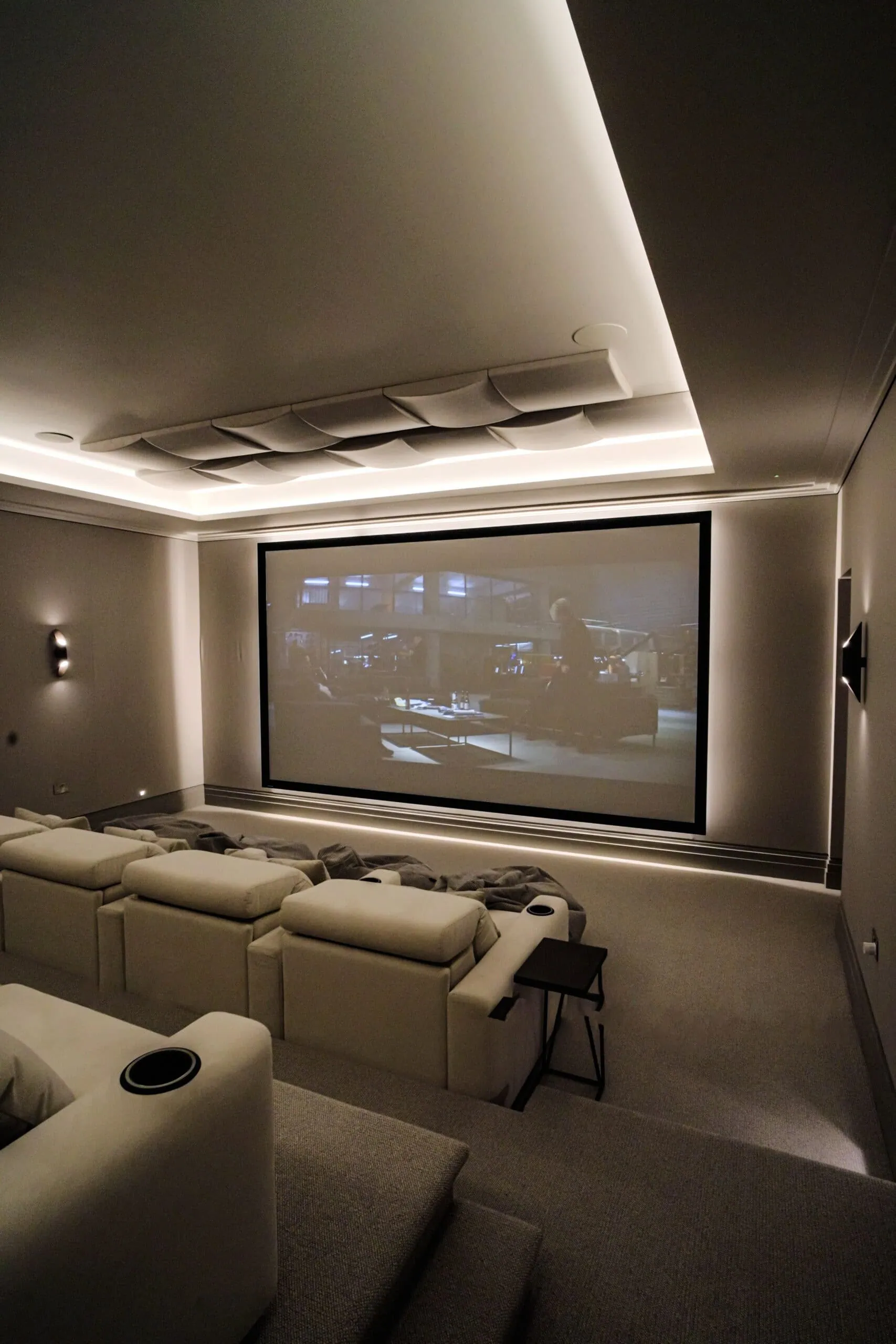
Our Roehampton Gate basement cinema in London, a 7 by 8 metre room for a couple and their five children, uses nine ear-level speakers, four overhead Atmos channels and four subwoofers. In Dolby’s notation that is 9.4.4. The subwoofers were positioned and tuned with room-analysis software to remove bass dead zones, so the back row hears what the front row hears.

Where should the overhead speakers go?
Dolby’s installation guidelines are specific:
- Ear-level speakers sit at about 1.2 metres, the average seated ear height, and ideally at the same distance from the main seat.
- In a 7.1.4 layout, the angle up from the main seat to the top front and top rear speakers should be 45 degrees, adjustable between 30 and 55 degrees.
- Overhead speakers should be two to three times the height of the ear-level speakers.
- Overhead speakers should be timbre-matched to the main speakers, meaning voiced to sound alike, and wide-dispersion models can face straight down.
- Do not put every speaker in the ceiling. Dolby says there must be separation between the ear-level and overhead speakers for the best result.
Real rooms rarely match the diagram. That is why we plan speaker positions for the room you actually have rather than a textbook rectangle, and show you them in 3D before anything is cut. It is the core of our home cinema design process.
What if you cannot put speakers in the ceiling?
Dolby Atmos enabled speakers fire upwards and bounce sound off the ceiling. They come built into a front speaker or as a separate module that sits on top of one. Dolby’s guidelines say they work best with a flat, reflective ceiling between 2.3 and 4.3 metres high, ideally 2.3 to 3.66 metres, and that in a room with a low ceiling, where in-ceiling speakers would be too close to your head, they can be the better choice.
Where the ceiling allows, the dedicated cinemas we have published use in-ceiling Atmos speakers: KEF Ci200QR models in Weybridge and Sonance VP62 in-ceiling speakers in Fetcham. A concrete ceiling or a very low basement can change that decision, which is one reason to measure early; our guide to basement cinema rooms covers ceiling height.
Will films that are not mixed in Atmos use the ceiling speakers?
They can. Dolby’s guidelines describe the Dolby Surround upmixer, included in Dolby Atmos processing, which expands stereo, 5.1 and 7.1 soundtracks across a Dolby Atmos system and uses the overhead speakers for atmosphere. To keep the front image accurate, it does not send upmixed sound to the wide speakers.

How do you choose the right layout for your room?
- Room size and rows. One row in a small room: 5.1 or 5.1.2. Two rows or a larger room: seven ear-level speakers with two overhead as a minimum, and 7.1.4 or beyond where the ceiling and budget allow.
- The ceiling. Its height, shape and what it is made of decide whether overhead speakers go in it, and where.
- The processor. Dolby notes that four overhead or enabled speakers need an AV receiver or processor with four height outputs, so plan for the layout you might grow into.
- Calibration. Dolby recommends checking automatic calibration by hand, especially subwoofer and enabled speaker levels, which some systems set incorrectly.
- The room itself. Dolby also recommends absorbing and diffusing treatment to control reflections; our guide to acoustic treatment and soundproofing explains what that means.
Our luxury home cinema service designs the speaker layout, the room and the equipment together, so the number on the box matches what the room can actually deliver.
The best way to understand overhead sound is to hear it. Our Walton-on-Thames demonstration cinema runs a Lyngdorf 7.2.2 system with a 2.8 metre wide acoustically transparent screen. Book a showroom visit and listen for yourself.
Frequently asked questions
Is 5.1.2 enough for Dolby Atmos?
For a smaller room with one row of seats, 5.1.2 is a sound starting point and gives genuine overhead sound. Larger rooms and second rows benefit from more speakers, such as 7.1.4, so sound can move from front to back overhead.
Do I need four overhead speakers?
No, two overhead speakers make a valid Dolby Atmos layout, and both our Oxshott cinema and our showroom run 7.2.2. Four overhead speakers let effects travel front to back across the ceiling, which is the step up in Dolby’s 7.1.4 layout.
Are upward-firing Dolby Atmos speakers as good as ceiling speakers?
They can work very well in the right room, and Dolby says they may be the better choice where a low ceiling would put in-ceiling speakers too close to your head. They need a flat, reflective ceiling, which Dolby puts at 2.3 to 4.3 metres high.
Why would a home cinema have more than one subwoofer?
Mainly to make bass even from seat to seat. Dolby Atmos carries a single low-frequency effects signal, so extra subwoofers are about coverage; in our Roehampton Gate cinema, four subwoofers were positioned and tuned with room-analysis software to remove bass dead zones.
Can I add Dolby Atmos to my existing surround system?
Usually, yes. Dolby says most existing speakers work for Atmos playback and can be joined by overhead or Dolby Atmos enabled speakers, added in pairs, as long as your AV receiver or processor has enough height outputs.