

Sonance, based in San Clemente, California, has specialised in speakers built into walls and ceilings since 1983, and its Invisible Series can be finished over so nothing shows. It is a strong choice when appearance comes first. The trade-offs are lower sensitivity and limited deep bass from the invisible models, and a commitment made before the plastering starts.
Last reviewed: 26 October 2026
Sonance tends to come up when a room has been drawn with nothing on the walls. This Sonance review looks at the company behind that reputation, what it does well and where it asks you to compromise. For the ranges we install and where to hear them, see our Sonance invisible and architectural speaker page.
Where did Sonance come from, and who is behind it today?
Scott Struthers and Geoff Spencer started Sonance in 1983, and the company credits them with introducing the world’s first in-wall loudspeaker. That is Sonance’s own claim, made on its company page, which also names San Clemente, California as its home base. Whoever was first, the idea of hiding speakers in the building fabric is the thread that runs through everything the company has done since.
The corporate story is less well known. For years Sonance sat alongside IPORT and TRUFIG under a parent called Dana Innovations. In September 2019 Residential Systems reported a rebrand that made Sonance the name over the whole company, and the same week Sonance announced an agreement to acquire James Loudspeaker. Today its company page presents James and IPORT as part of Sonance. Sonance does not publish details of who owns it, so I will not guess.
The other name you may see on a Sonance-designed product is Sonos. Sonos says its UK in-ceiling, in-wall and outdoor speakers come from a collaboration with Sonance, which tells you how far the company’s reputation in architectural audio reaches.
What is Sonance best known for?
The Invisible Series is the headline. These are panels that sit flush with the plasterboard and are skimmed over, so the wall or ceiling looks untouched. The Invisible Series collection includes the IS6, IS8 and IS10 speakers and IS10W in-wall woofers (checked 14 October 2026), and Sonance’s specification for the IS6 says it accepts up to 3mm of topping compound and can be finished in plasterboard, some plasters, wallpaper, leather or wood veneer.
Behind that sit conventional ranges. Sonance’s residential music page lists the Visual Experience Series, Natural Collection, Small Aperture Series and Hidden Bass subwoofers (checked 14 October 2026). Then there is outdoor audio, from garden systems to terrace speakers, and a commercial side that covers bars and restaurants.

Why do designers and homeowners pick Sonance?
Three projects show the range of reasons.
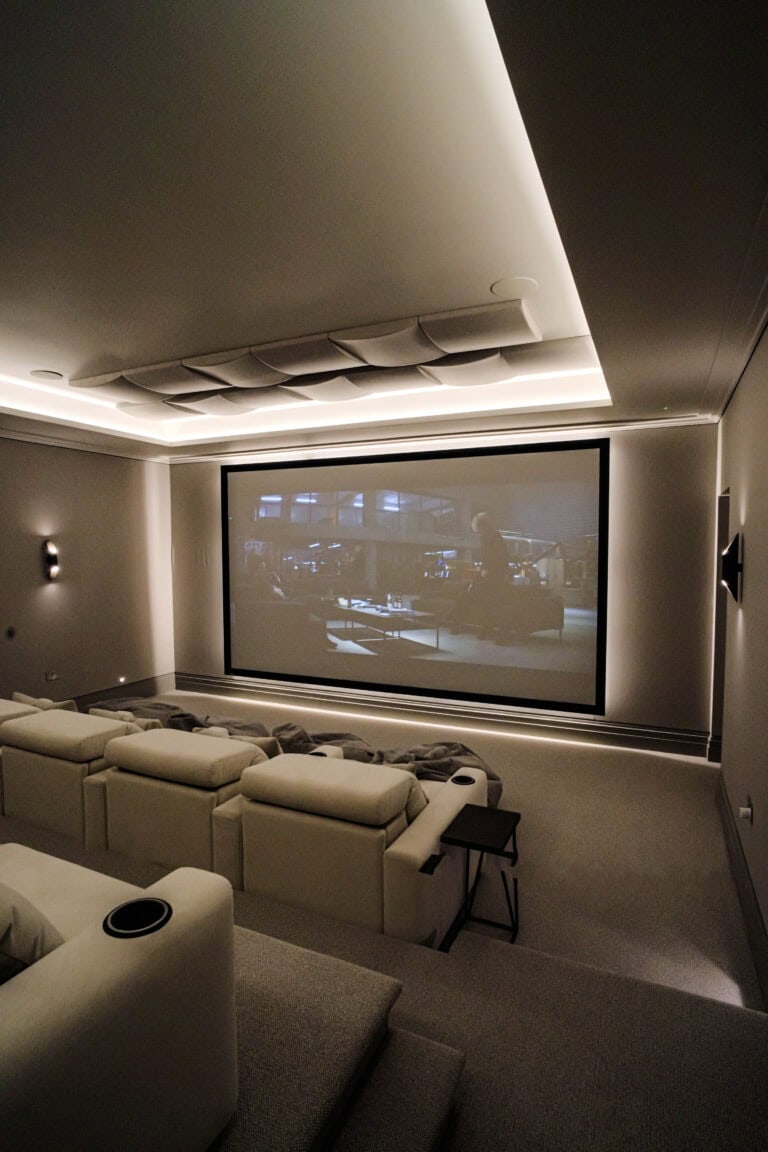
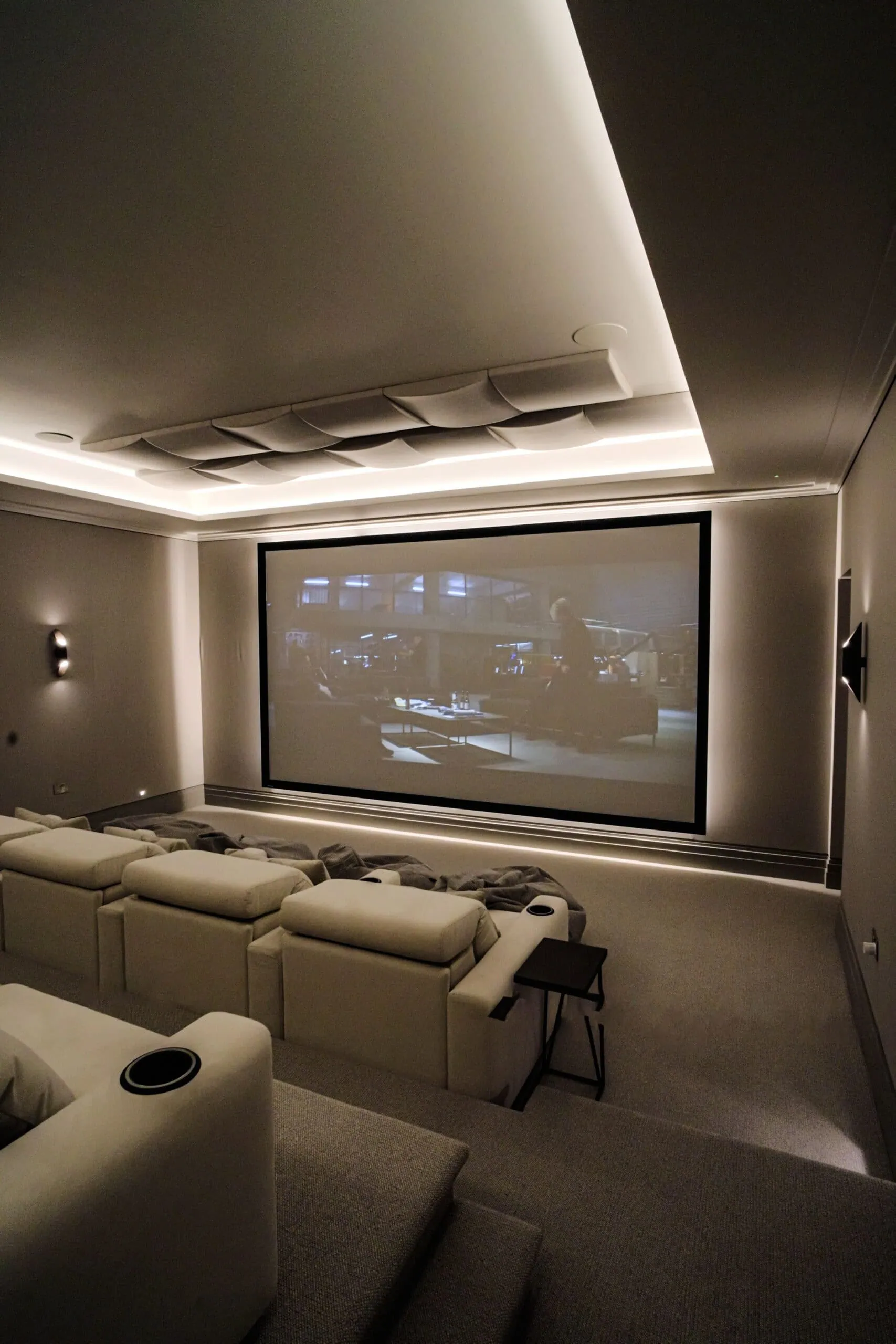
- A full cinema with nothing on show. In our Fetcham cinema with a bar and pool table, Sonance in-wall speakers sit behind a 126-inch acoustically transparent screen and handle the surrounds, Sonance in-ceiling speakers provide the Dolby Atmos height channels, and a Sonance in-wall subwoofer handles bass. The family had been let down by the systems in their previous house, so dependable operation counted for as much as appearance.
- Indoor and outdoor in one design. For a bar and rooftop terrace in Canary Wharf we designed a Sonance commercial system with outdoor-rated speakers on the roof, so the music carries from inside to out.
- Hearing is believing. Our Walton-on-Thames showroom has Sonance invisible audio, and listening to music come out of a plain wall usually settles the question.
What are the pros and cons of Sonance speakers?
Pros
- A genuinely invisible option, which very few makers offer at this level, plus grilled ranges for rooms that need them.
- Wide coverage from the invisible panels: Sonance quotes 170-degree hemispherical dispersion for the IS6 (checked 14 October 2026).
- One maker for indoor, outdoor and commercial audio, which keeps a whole-house design consistent.
- Over four decades of experience with speakers built into walls.
Cons
- Invisible panels are less sensitive. The IS6 specification gives 84dB, which is low for an architectural speaker, so they need more amplifier power for the same volume (checked 14 October 2026).
- Limited deep bass. The same specification quotes a 50Hz lower limit, which is why Sonance sells matching in-wall woofers to go alongside. Smaller grilled models can be similar: a Residential Systems review of the older Visual Performance range found the smallest model, with a 4.5-inch driver, a bit thin in the bass and recommended a subwoofer.
- You commit early. Invisible speakers go in before the skim coat, and changing your mind later means replastering and redecorating.

Who should choose Sonance, and who should not?
Sonance suits homes where the architecture leads: a period drawing room, a minimalist new build, a kitchen with a smooth plaster ceiling. It suits clients who are renovating anyway, because invisible speakers need to go in at first fix. And it suits people who want the garden, the terrace and the house to come from one family of products.
It is less suited to a finished house you do not want to disturb, to anyone who expects to swap speakers every few years, or to a dedicated cinema where every speaker must be aimed precisely at the seats. In that last case Sonance’s grilled models do the job, as they do in Fetcham, but the invisible panels are not the right tool. Our guide to smart lighting in listed and period homes covers the same planning questions for lighting.
How does Sonance fit a Control4 and Lutron home?
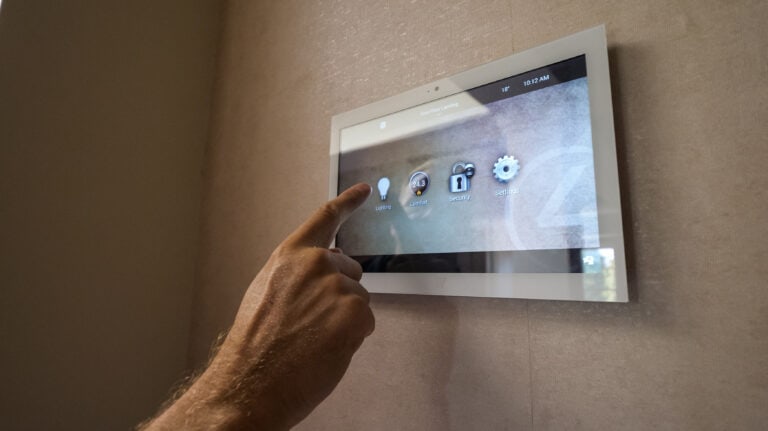
Sonance speakers are passive, so they connect to an amplifier or AV receiver, and Control4 controls that. In Fetcham an Anthem receiver drives the cinema and Control4 runs the system. Around a house, Control4 selects the source, sets each room’s volume and folds music into scenes, while Lutron handles the lighting.
Set up that way, a single keypad button can start music from a plain wall and dim the lights at the same moment. As a Platinum Control4 dealer we design the speakers, amplification and scenes together, and our multi-room AV page explains how the zones are planned.
Frequently asked questions
Who owns Sonance?
Sonance does not publish its ownership. Since a 2019 rebrand it has been the name over the company that was previously called Dana Innovations, and its company page presents James Loudspeaker and IPORT as part of Sonance.
Do Sonance invisible speakers sound as good as normal speakers?
They sound clear and spread well across a room, but they are less sensitive and lighter in deep bass than a good grilled speaker of the same size. For background and everyday listening that rarely matters. For serious music listening or a cinema, add a woofer or choose grilled models.
Do Sonance speakers need a subwoofer?
For full-range sound, usually yes. Sonance specifies its smallest Invisible Series speaker down to 50Hz (checked 14 October 2026), and Sonance offers dedicated in-wall woofers for its Invisible Series and Hidden Bass subwoofers for its other ranges.
Can I hear Sonance before deciding?
Yes. A visit to our Surrey showroom lets you hear Sonance invisible audio next to a working Control4 system, by appointment. You can also contact us to talk through a project.