
An acoustically transparent screen is a projection screen woven or perforated finely enough for sound to pass through it, so the left, centre and right speakers can sit behind the picture. Dialogue then comes from the actors on screen, and the speakers disappear. The trade-offs are slight high-frequency loss, a deeper front wall and higher cost than a solid screen.

What is an acoustically transparent screen?
A normal projection screen is a solid sheet of vinyl or fabric. Put a speaker behind it and the sound is muffled. An acoustically transparent (AT) screen has thousands of tiny openings, so sound passes through while the surface still reflects the projector’s light. Stewart Filmscreen explains that woven screens rely on the gaps between the fibres, while perforated screens are flat vinyl with punched holes.
From the seats it looks like any other screen. The difference is what sits behind it: the front left, centre and right speakers, hidden in a cavity between the screen and the front wall.
Why put the speakers behind the screen?
Commercial cinemas put their screen speakers behind the screen, and the same logic works at home. Three reasons matter most:
- Dialogue comes from the picture. When the centre speaker sits behind the middle of the image, voices appear to come from the actors rather than from a box below the screen. Draper recommends placing the centre speaker behind the screen, level with the left and right speakers, for exactly this reason.
- Matched speakers across the front. With no need to squeeze a short centre speaker under the screen, the left, centre and right can be identical models, so sound pans smoothly from one side of the picture to the other.
- A bigger picture. Speakers no longer need wall space beside or beneath the screen, so the image can fill more of the front wall. For how big to go, see our guide to home cinema screen size and viewing distance.
There is also the look. With the speakers hidden, the room becomes a calm, dark space focused entirely on the picture, which is a large part of what makes a dedicated luxury home cinema feel different from a living room with a big TV.
Woven or perforated: which is better?
Both work well. They suit different rooms.
Woven screens
Woven fabrics have a fine, irregular texture, which makes the pattern harder to see up close, and they generally lose less treble. Draper’s published figures for its own woven materials show an average insertion loss (the drop in sound level through the screen) of 0.7 dB for White Weave XT900E and 0.8 dB for Grey Weave XH600E. Stewart notes that woven screens can add a slight sparkle to the image.
Perforated screens
Perforated screens are a smooth vinyl surface with a grid of small holes. Draper quotes an average loss of 1.7 dB for its micro-perforated NanoPerf and 2.2 dB for its larger-hole Perf XT900V. The larger holes are easier to see, so Draper does not recommend that material for viewing closer than 20 feet, about 6 metres, and suggests reasonable control of ambient light.
| Draper material | Type | Average insertion loss | Closest recommended viewing |
|---|---|---|---|
| White Weave XT900E | Woven | 0.7 dB | 10 feet (about 3 m) |
| Grey Weave XH600E | Woven | 0.8 dB | 10 feet (about 3 m) |
| NanoPerf XT900V | Micro-perforated | 1.7 dB | 10 feet (about 3 m) |
| Perf XT900V | Perforated | 2.2 dB | 20 feet (about 6 m) |
These are Draper’s own figures from its guide to behind-screen speakers. Other manufacturers test in different ways, so compare like with like. As a rule of thumb, if your front row sits close to the screen, a woven or micro-perforated material is the safer choice. Coarser perforations suit larger rooms where everyone sits further back.
Does an acoustically transparent screen affect sound quality?
A little, and mainly at the very top end. Every AT screen absorbs some sound, and the loss is greatest at high frequencies. Draper’s woven materials reach their maximum loss at 20,000 Hz, 2.0 dB for White Weave and 2.8 dB for Grey Weave. Across 85 to 255 Hz, the range Draper gives for typical adult speech, the loss is less than a decibel for all of its AT surfaces.
The fix is equalisation. Stewart Filmscreen says compensation is done with EQ, using accurate data from the screen manufacturer or measurements taken by the installer, and that modern digital room correction has replaced the separate processors once sold for the job. The practical point for you: the system should be calibrated with the screen fitted, not before it goes up.
What about moiré, seating distance and screen size?
Moiré is a shimmering interference pattern that can appear when the projector’s pixel grid lines up with the screen’s weave or holes. Stewart Filmscreen notes that it depends on the projector: Sony’s SXRD and JVC’s D-ILA projectors show very little moiré at 4K, while DLP projectors need more careful matching to the screen. If you are still choosing a projector, our guide to laser and lamp projectors covers the other trade-offs.
Two other limits are worth knowing before you commit:
- Minimum seating distance. Sit too close and you may notice the texture. Draper’s recommendations range from about 3 metres for its finest materials to about 6 metres for its coarse perforation.
- Minimum screen size. Draper does not recommend its AT materials for screens narrower than 80 inches, about 2 metres, because of moiré.
How much space does an acoustically transparent screen need?
The speakers have to go somewhere, so an AT screen moves the viewing surface forward into the room. The screen is mounted on a frame or false wall in front of the speakers, and the depth of that cavity depends on the speakers you choose and the screen maker’s recommended gap. In a short room, that lost depth can push the front row too close, so it needs to be planned alongside the cinema room layout rather than added at the end.
Two details make a real difference:
- Keep it black behind the screen. Light passes through the openings as well as sound. Stewart says the gaps must be small enough to limit projector light reflecting back from behind the screen, and that a black backing or mask helps, at some cost to how freely sound passes through.
- Plan for access. Speakers and cables behind a fixed screen still need occasional attention, so a removable frame or access route saves a lot of disruption later.
Is an acoustically transparent screen worth it?
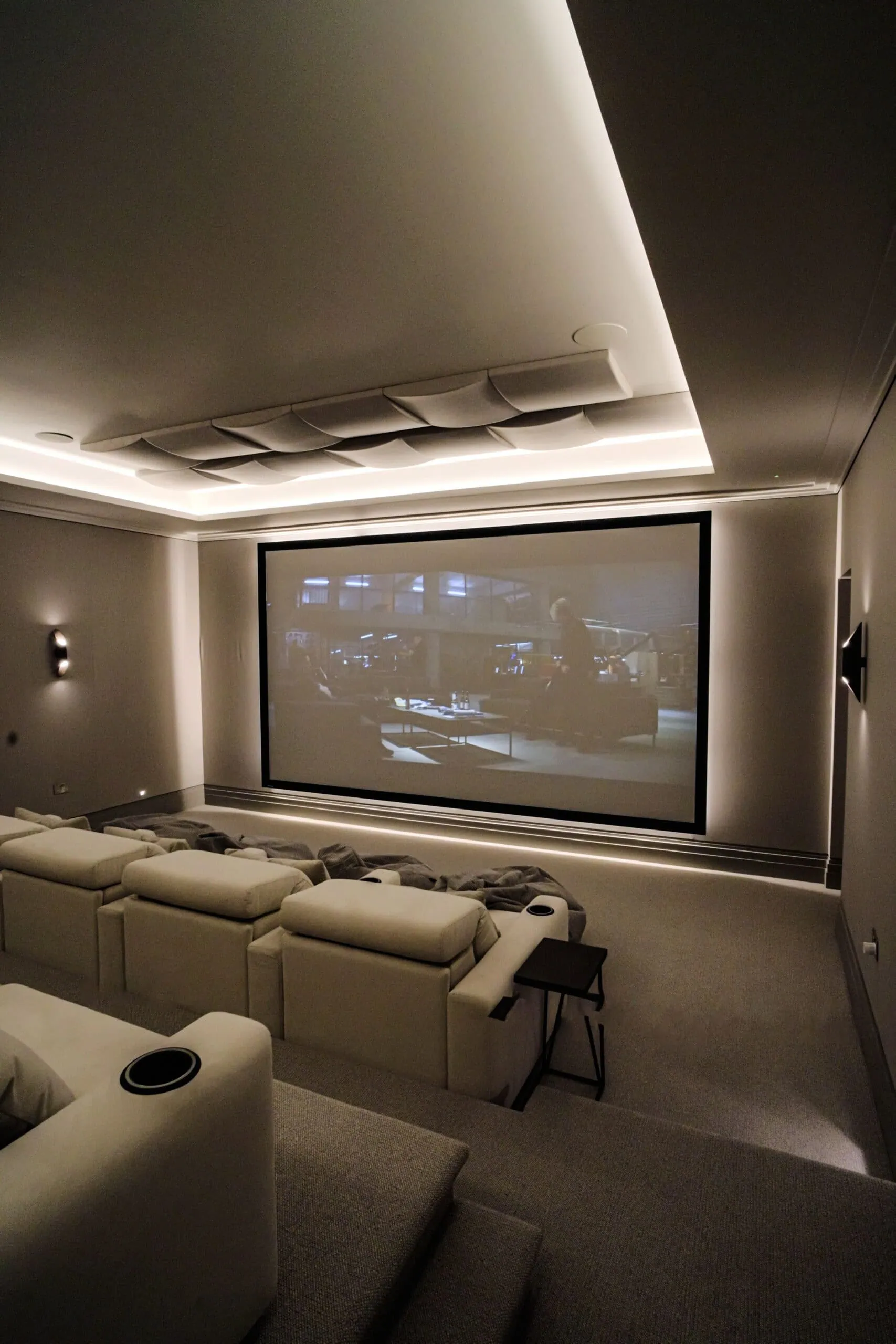
For a dedicated cinema with a projector and enough room depth, usually yes. It is the most effective way to put voices where the actors are and to hide the front speakers completely. Our basement cinema at Roehampton Gate, for example, pairs a high-gain acoustically transparent screen with a 4K image; you can read how that room came together in the Roehampton Gate case study.
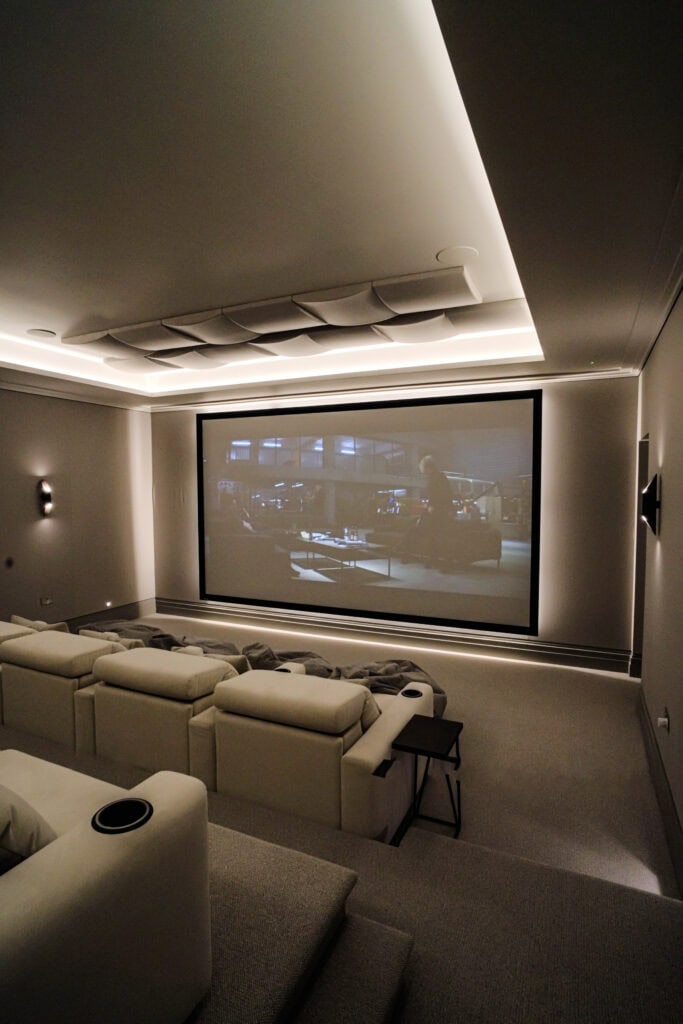
It makes less sense when:
- the room is a multi-purpose space built around a large TV rather than a projector, where a media room design with in-wall or on-wall speakers is the better fit;
- the room is short, and the speaker cavity would push the front row too close to the screen;
- the budget would do more good spent first on the projector, seating or acoustic treatment.
The best way to decide is to hear one. The demonstration cinema at our Walton-on-Thames showroom has a 2.8 metre wide acoustically transparent screen with a Sony 4K laser projector and a Lyngdorf Audio 7.2.2 sound system, so you can listen to dialogue coming through the screen and judge the picture from different seats. Book a visit to the showroom at Unit 101, Image Court, 326 Molesey Road, Walton-on-Thames, KT12 3PD, or call 020 3397 9888.
Frequently asked questions
Can I use an acoustically transparent screen with a TV?
No. AT screens are projection screens. With a TV, the speakers sit around or below the picture instead. If you want the speakers directly behind the image, you need a projector and an AT screen.
Do I need EQ with an acoustically transparent screen?
It is good practice. The screen trims a small amount of treble, so the system should be calibrated with the screen fitted, using the manufacturer’s data or measurements taken in the room.
Is woven or perforated better for a small cinema room?
Where the front row sits close to the screen, a woven or micro-perforated material is usually the safer choice because its texture is harder to see up close. Always check the manufacturer’s minimum viewing distance for the specific material.
Will I see the speakers through the screen?
Not in a properly built room. The cavity behind the screen is kept dark, and a black backing or mask limits light reflecting back through the openings, so from the seats you see only the picture.