There is no single standard movie screen size, so size a home cinema screen from your seat. THX divides the screen size by 0.835 to give the ideal maximum seating distance, about 40 degrees for 16:9. SMPTE’s 30 degrees puts you about 1.6 times the diagonal away. A 120 inch screen suits a main row 3.6 to 5 metres back.
Last reviewed: 14 October 2026
What do SMPTE and THX recommend?
Both measure how wide the screen looks from your seat, as an angle. Kaleidescape’s screen size guide summarises the two: SMPTE, the Society of Motion Picture and Television Engineers, recommends a 30 degree field of view, while THX recommends a viewing angle of approximately 40 degrees for an immersive, cinematic experience. Kaleidescape turns the 40 degree figure into arithmetic: multiply your viewing distance in inches by 0.835 to get the screen size.
THX’s own rule of thumb runs the other way: divide the screen size by 0.835 to get the ideal maximum distance, in inches, between your sofa and the screen. For a 16:9 screen, both work out at almost exactly 40 degrees. For commercial cinemas, THX recommends a 36 degree viewing angle from the farthest seat.
Our own design work uses a comfortable range of 33 to 40 degrees, and it starts with the seats, not the screen.
How far should you sit from each screen size?
Measure from the screen wall to where your eyes will be in the main seat, not to the front edge of the seat; with recliners, check the distance both upright and reclined. Then compare it with the table. These are our own calculations for 16:9 screens, using the same geometry as the rest of this guide: the closest distance gives THX’s 40 degrees, the middle column gives the 33 degrees at the far end of our design range, and the last column gives SMPTE’s 30 degrees. All figures are rounded to the nearest 10 centimetres.
| Screen size (16:9) | Screen width | Seat at 40 degrees (THX) | Seat at 33 degrees | Seat at 30 degrees (SMPTE) |
|---|---|---|---|---|
| 55 inch | 1.22 m | 1.7 m | 2.1 m | 2.3 m |
| 65 inch | 1.44 m | 2.0 m | 2.4 m | 2.7 m |
| 75 inch | 1.66 m | 2.3 m | 2.8 m | 3.1 m |
| 85 inch | 1.88 m | 2.6 m | 3.2 m | 3.5 m |
| 97 inch | 2.15 m | 2.9 m | 3.6 m | 4.0 m |
| 100 inch | 2.21 m | 3.0 m | 3.7 m | 4.1 m |
| 110 inch | 2.44 m | 3.3 m | 4.1 m | 4.5 m |
| 120 inch | 2.66 m | 3.6 m | 4.5 m | 5.0 m |
| 126 inch | 2.79 m | 3.8 m | 4.7 m | 5.2 m |
| 135 inch | 2.99 m | 4.1 m | 5.0 m | 5.6 m |
| 150 inch | 3.32 m | 4.6 m | 5.6 m | 6.2 m |
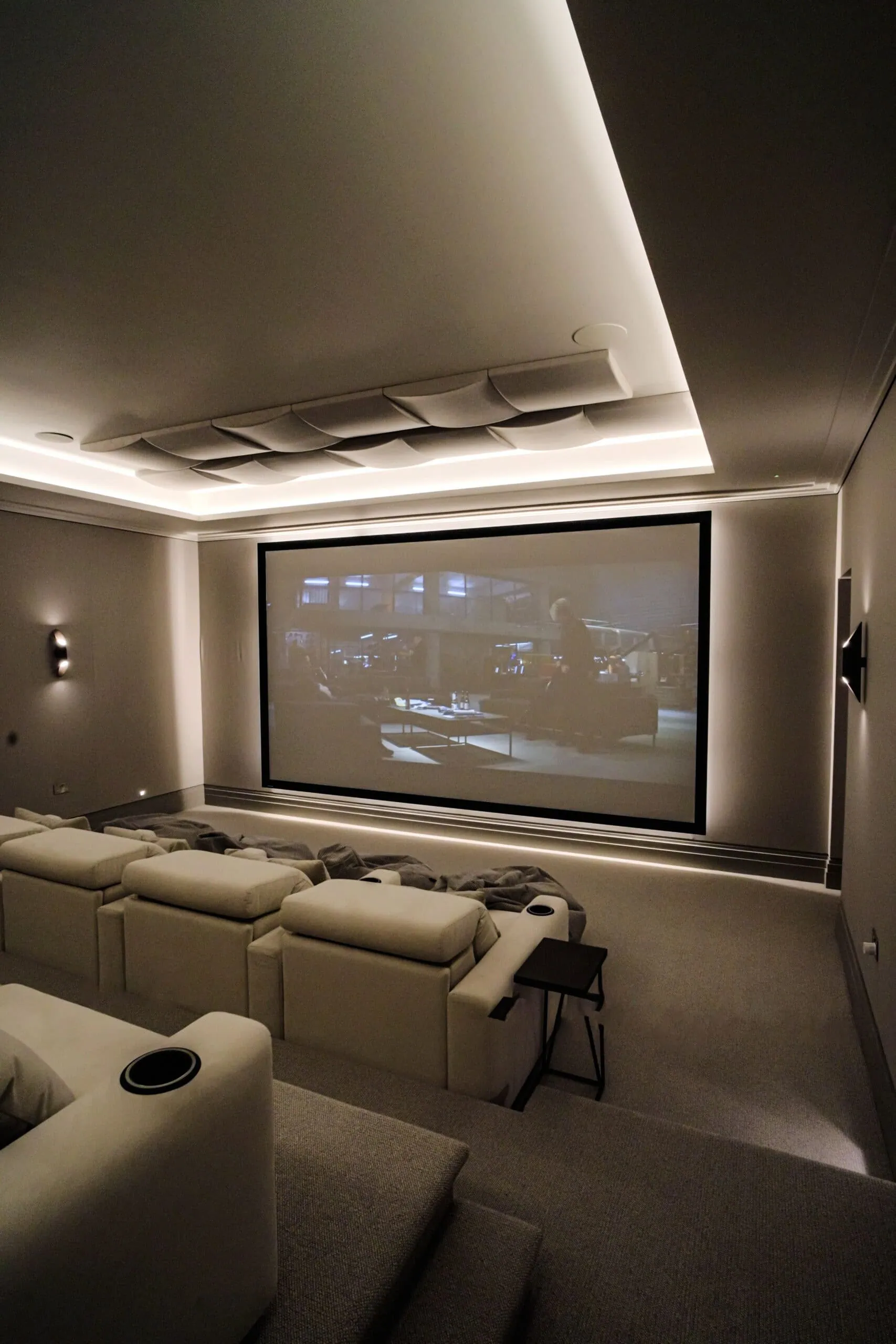
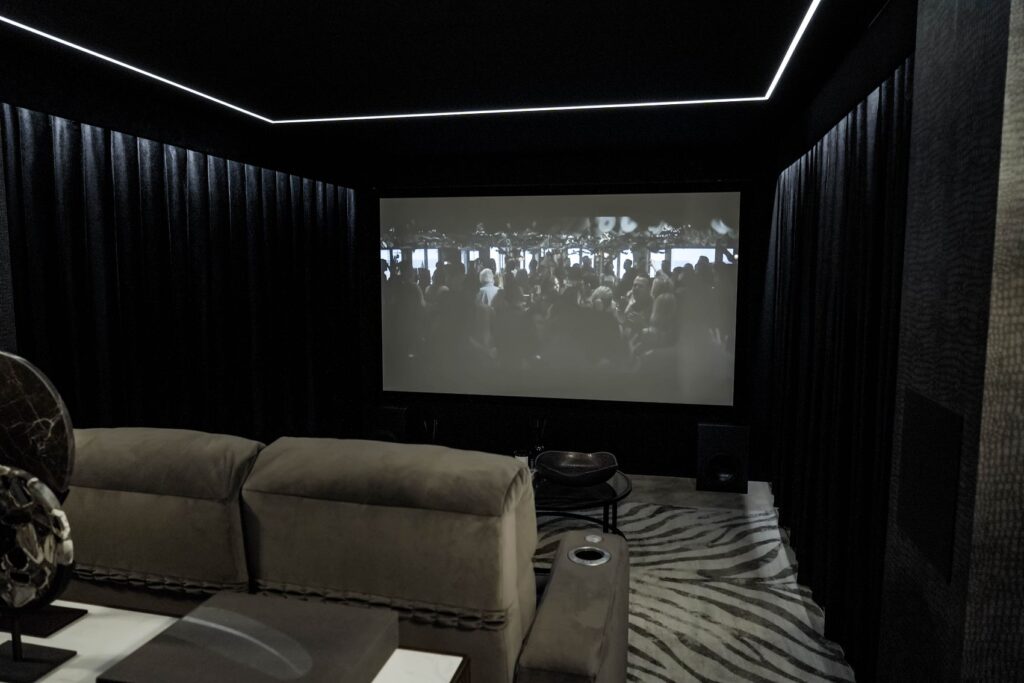
Sit much closer than the 40 degree figure and the picture becomes uncomfortable to take in. Sit further back than the 30 degree figure and the screen loses its impact. Our showroom cinema is a working example: its acoustically transparent screen is 2.8 metres wide, which by the same maths gives 40 degrees at about 3.8 metres and 30 degrees at about 5.2 metres.
What is a standard movie screen size?
There is no single standard movie screen size, in a commercial cinema or at home. What is standard is the shape of the picture. Digital films for cinemas are delivered in two main shapes, Flat at 1.85:1 and Scope at 2.39:1, and each auditorium’s screen is sized to its room. At the very top end, BFI IMAX in London calls itself the UK’s biggest screen, roughly 26 metres wide and 20 metres high.
At home, sizes are quoted as a diagonal in inches, and each manufacturer sets its own range. When we checked on 14 October 2026:
- TVs: LG lists a 97 inch OLED evo G5 on its UK site.
- Fixed projection screens: Elite Screens lists its Sable Frame 2 in 16:9 sizes from 100 to 200 inches, plus 138 and 158 inch models in 2.35:1.
- Masking screens: Stewart Filmscreen’s Director’s Choice shows any aspect ratio, in sizes from 84 by 96 inches up to 168.5 by 300 inches.
- Projectors: Epson lists a projected image size of 50 to 300 inches for its EH-LS12000B. See our Epson projector installations.
What screen sizes do home cinemas typically use?
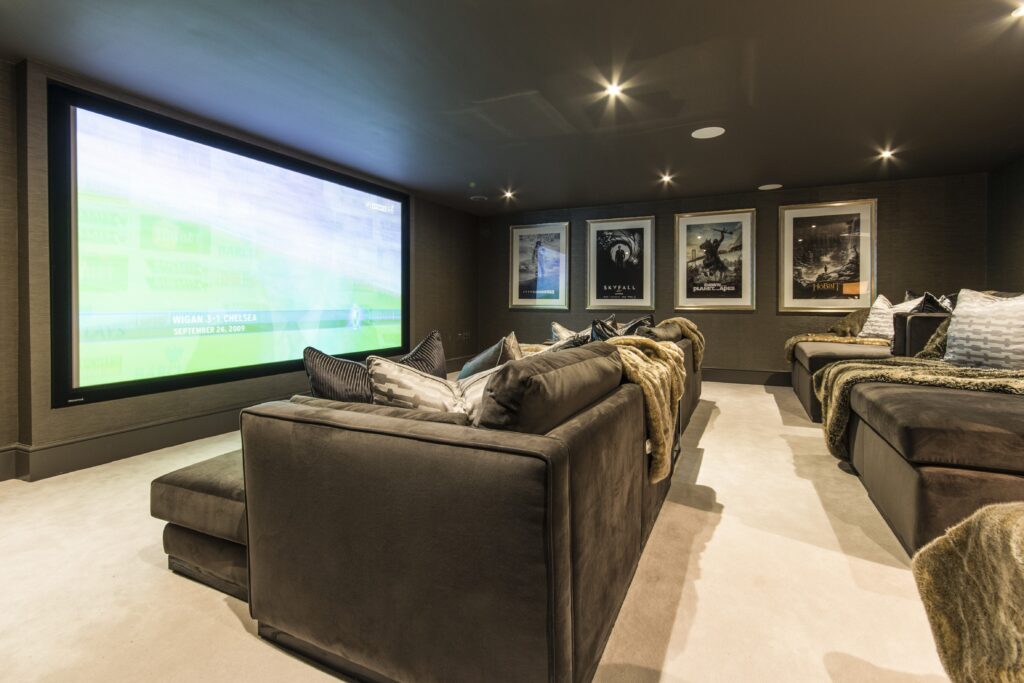
In the rooms we have built, 120 to 126 inches is the most common size for a dedicated cinema. Our Oxshott cinema has a 120 inch acoustically transparent screen, Esher has a motorised 120 inch screen that drops in front of an 85 inch TV, and our Weybridge and Fetcham cinemas both use 126 inch Projecta acoustically transparent screens. Our projection screens page covers the Projecta and Draper models we fit.
Smaller rooms need smaller screens. In a small cinema room of 12 to 16 square metres, we plan around a screen about two metres wide, which is about 90 inches in 16:9 by our arithmetic. Media rooms with some daylight often suit a 75 or 85 inch TV better than a projector.
The diagonal only means something alongside the screen’s shape. Kaleidescape notes that nearly all home cinema projectors have a native aspect ratio of 1.78:1, which is 16:9, while many feature films use the wide CinemaScope shape of 2.35:1 to 2.40:1. This is what screens from 100 to 150 inches measure in each shape. The figures are our own calculations, in metres, width by height:
| Diagonal | 16:9 screen | 2.39:1 screen |
|---|---|---|
| 100 inch | 2.21 x 1.25 | 2.34 x 0.98 |
| 110 inch | 2.44 x 1.37 | 2.58 x 1.08 |
| 120 inch | 2.66 x 1.49 | 2.81 x 1.18 |
| 135 inch | 2.99 x 1.68 | 3.16 x 1.32 |
| 150 inch | 3.32 x 1.87 | 3.51 x 1.47 |
At the same diagonal, a 2.39:1 screen is a little wider but much shorter. That is why many dedicated cinemas are designed as constant height. Kaleidescape describes a scope screen where an anamorphic lens stretches the projector’s 16:9 image to fill the width, so films always fill the screen from top to bottom, and masking panels cover the unused parts when you watch something narrower. It also describes a 2.0:1 screen with masking on all four sides, used with a projector that can zoom and shift the image to memorised positions. Epson, for example, lists ten lens position memories on the EH-LS12000B. By our arithmetic, a 2.39:1 screen as tall as a 120 inch 16:9 screen is about 3.57 metres wide, roughly 152 inches on the diagonal.
Our showroom cinema shows why the diagonal alone can mislead. Its acoustically transparent screen is 2.8 metres wide. In 16:9, that width is about a 126 inch screen; in 2.39:1, it is about 120 inches. Whichever shape you choose, size it to your seats with the table above, then check the width against the wall. Our cinema room ideas show how real rooms have handled it.
What about the second row?
Put the front row near the 40 degree end of the range, then check the back row. THX’s 36 degrees from the farthest seat is a useful test for a two-row room: with a 120 inch 16:9 screen, 36 degrees is about 4.1 metres from the screen.
A worked example for two rows
Using our arithmetic again: with a 120 inch 16:9 screen, a front row at 3.6 metres sees about 40 degrees. Put the back row 0.9 metres further back, at 4.5 metres, and it sees about 33 degrees. Both rows sit inside the 33 to 40 degree range we design to, and the back row is still wider than SMPTE’s 30 degrees.
Push the back row to around 5 metres and it drops to SMPTE’s 30 degrees: acceptable, but less immersive than the front. That is the point to weigh up a bigger screen, which moves the front row back, or a different seating plan. It is the kind of trade-off we model in 3D before anything is built.
Height matters as much as width. THX suggests keeping your line of sight within 15 degrees of the centre of the screen, above or below. In a two-row room, that has to be balanced against the riser that lets the back row see over the front, which is why we design screen height, seat positions and riser height together. Oxshott is a good example: six Front Row recliners in two rows face its 120 inch screen, with the layout designed around a sloped ceiling. For more on seating, see our guide to cinema room layout.
Does 4K resolution change the answer?
A little. Kaleidescape’s guidance is that 2K is great at SMPTE’s 30 degrees, and 4K is worth it at THX’s 40 degrees. The closer you sit, the more detail you can see, so if you want the wide, immersive end of the range, specify a 4K display and 4K sources.
How big can you go with a TV?
Further than a few years ago. With LG listing a 97 inch OLED in the UK, and THX’s rule suggesting about 99 inches for a 3 metre viewing distance, a very large TV now reaches cinema viewing angles in many media rooms.
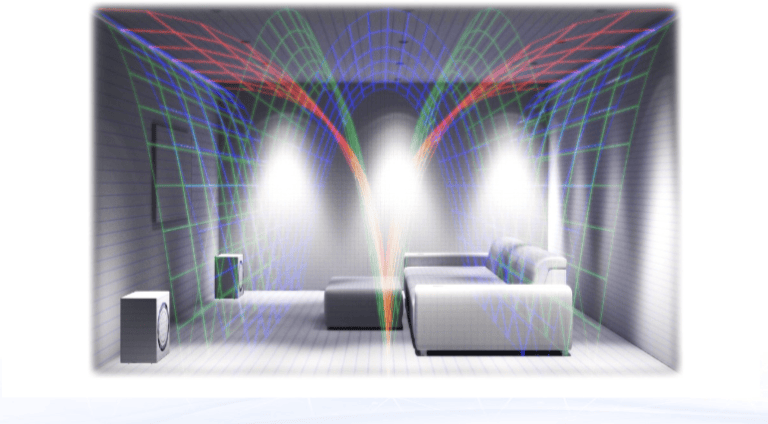
The trade-off is that a TV cannot hide speakers behind the picture the way an acoustically transparent projection screen can. Our guide to choosing a projector or a TV covers that decision, and our guide to Dolby Atmos speaker layouts explains where the other speakers go.
Why not simply go as big as the wall allows?
Because the seats set the limit, not the wall. Room size caps things too. In a small cinema room of 12 to 16 square metres, a 120 inch screen is beyond what the geometry supports. In larger rooms the question becomes how many rows you want and how far back the last one sits.
This is exactly the arithmetic our home cinema design process starts with, and we show you the result in 3D before anything is ordered. See our home cinema installation service for how the rest of the room comes together.
Bring your room measurements, or photos on your phone, and we will work out the right screen for your seats. Book a free design consultation.
Frequently asked questions
What is the standard movie screen size?
There is no single standard size. Commercial digital cinema uses two main shapes, Flat (1.85:1) and Scope (2.39:1), with each screen sized to its auditorium, and BFI IMAX in London is the UK’s biggest screen at roughly 26 by 20 metres. Home screens are sold by diagonal in inches.
What size screen do I need for a 3 metre viewing distance?
About 99 inches on a 16:9 screen if you follow the 0.835 rule, which works out at roughly 40 degrees. For SMPTE’s 30 degrees, about 73 inches is enough.
How far should I sit from a 120 inch screen?
Between about 3.6 and 5 metres for a 16:9 screen: 3.6 metres gives THX’s 40 degrees and 5 metres gives SMPTE’s 30 degrees. Our own design range of 33 to 40 degrees puts the main row between about 3.6 and 4.5 metres.
How far should I sit from an 85 inch TV?
About 2.6 metres for a THX-style 40 degree view, and up to about 3.5 metres for SMPTE’s 30 degrees.
How wide is a 120 inch screen?
By our calculations, a 120 inch 16:9 screen is about 2.66 metres wide and 1.49 metres high. A 120 inch 2.39:1 screen is about 2.81 metres wide but only 1.18 metres high.
How high should a home cinema screen be?
THX suggests keeping your line of sight within 15 degrees of the centre of the screen. In a two-row room, that is balanced against the riser height so the back row can see over the front.
Should a home cinema screen be 16:9 or 2.39:1?
It depends on what you watch most. A 16:9 screen matches the native shape of nearly all home cinema projectors, while a 2.39:1 constant-height screen lets widescreen films fill the whole screen, with masking to cover the sides for narrower pictures. We model both options in 3D for your room before anything is ordered.