
Who makes Projecta and Draper screens?
Projecta was founded in 1952 and builds its screens in Weert, in the Netherlands, in what Legrand describes as the largest projection screen factory in Europe. Projecta and Da-Lite became sister companies in 1991, both now part of Legrand AV, and they developed screen materials such as HD Progressive and Parallax together. In 2023 the Projecta name began moving across to Da-Lite. Production stayed in the Netherlands, so a screen ordered today from the same factory carries the Da-Lite badge. The models Legrand still lists under the Projecta name include the Tensioned Elpro Concept, the Tensioned DescenderPro, the FullVision borderless frame and the HomeScreen Deluxe.
Draper has made screens, shades and AV equipment in Spiceland, Indiana, since 1902. Its home cinema choices include:
- electric screens such as the Access V, recessed into the ceiling and tab-tensioned, the Ultimate Access, which closes behind a motorised trap door, and the free-hanging Targa for wall or ceiling fixing;
- fixed frames such as StyleLine, Profile+ and the Edgeless Clarion, which has no visible border;
- TecVision surfaces, which Draper makes in-house and puts through ISF certification for colour accuracy.
Acoustically transparent or solid: what the screen material decides
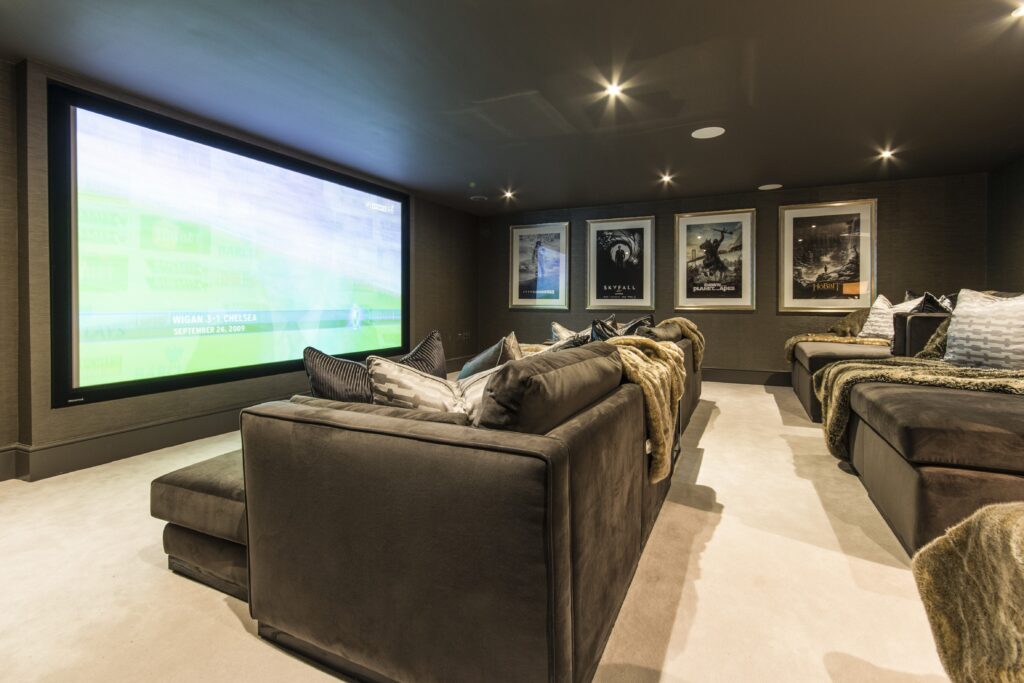
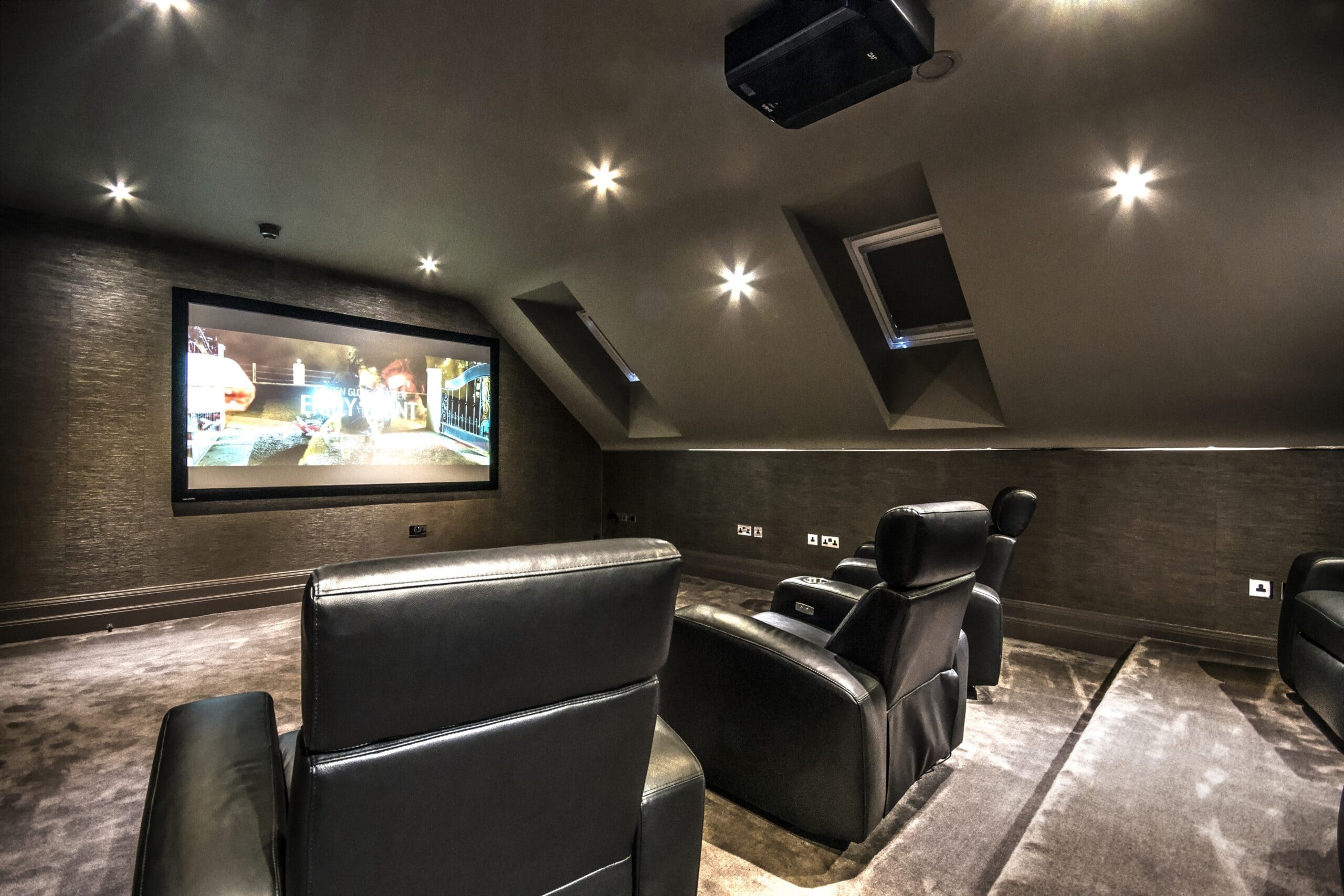
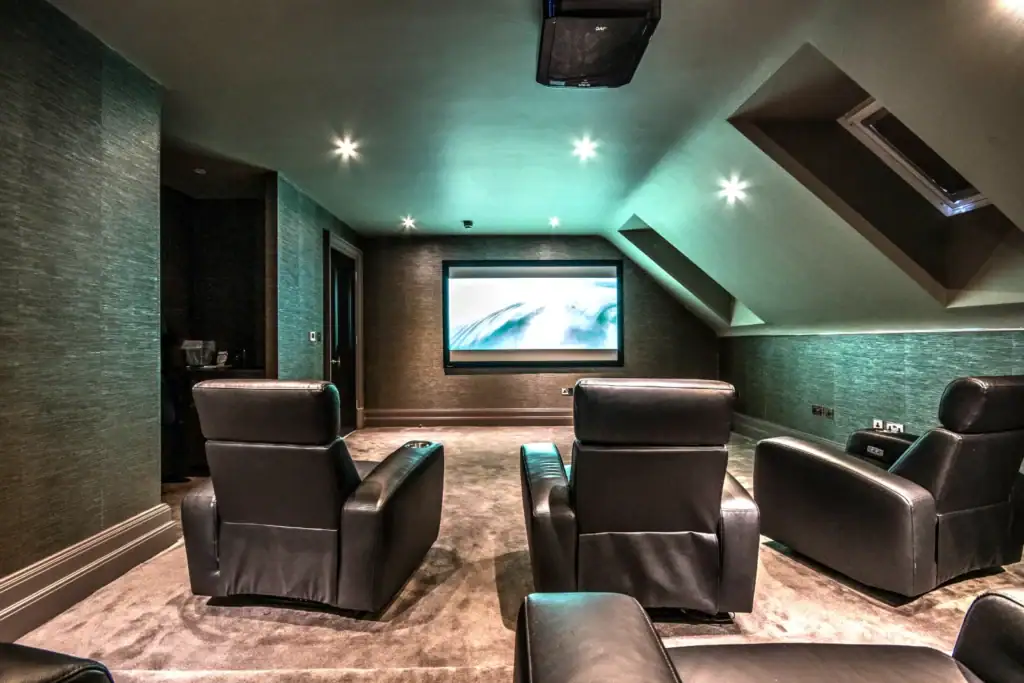
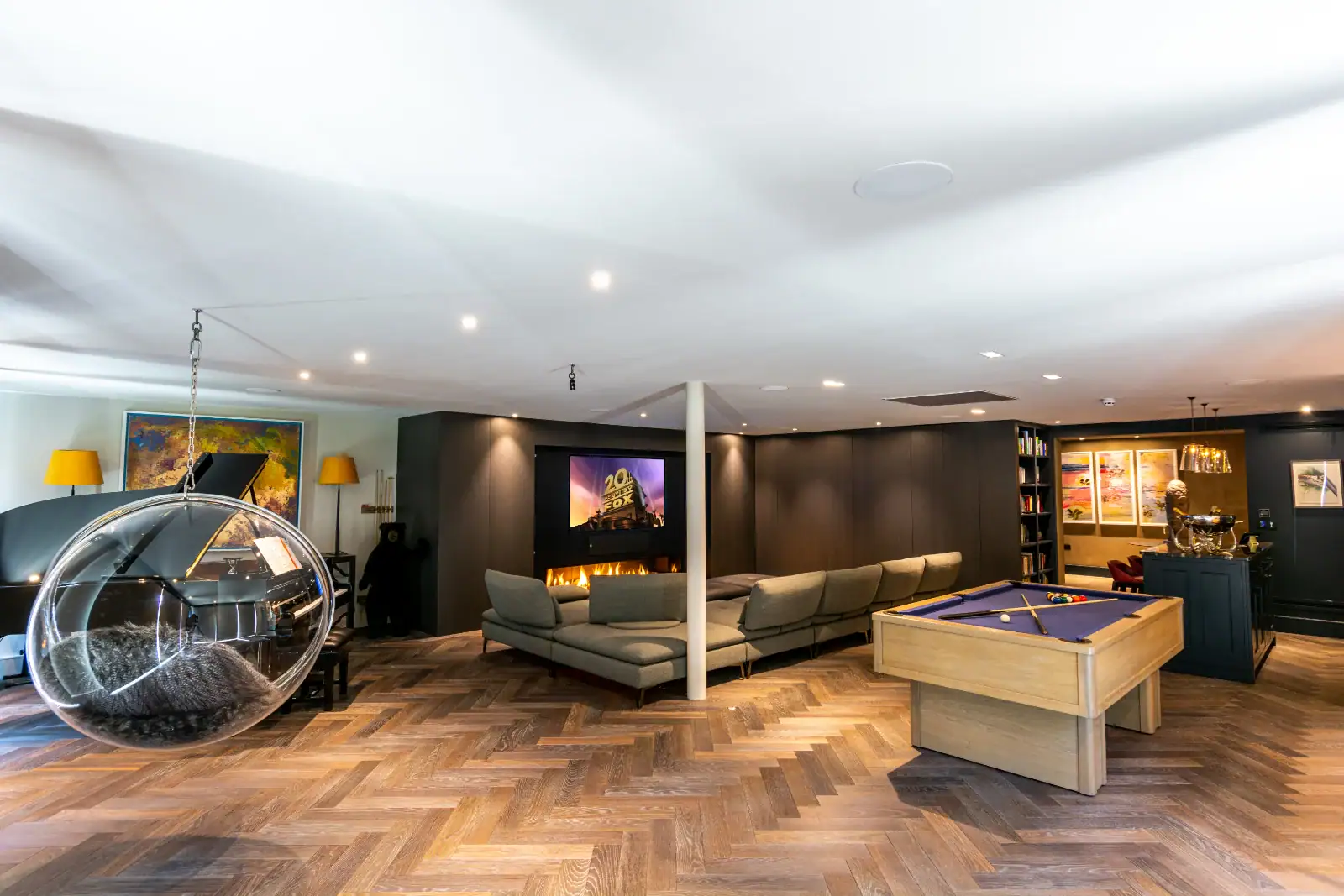
An acoustically transparent screen lets sound pass through it, so the front three speakers can stand behind the picture. Dialogue then comes from the actors' mouths rather than from below the screen, and the front wall stays plain, dark and uncluttered. That is why the Fetcham screen is acoustically transparent: its front speakers stand directly behind the picture.
There are two ways of letting sound through. A perforated surface has fine holes punched across it: Legrand's Da-Lite chart lists HD Progressive 1.0 Perf as the acoustically transparent member of the HD Progressive family, and Draper's ClearSound NanoPerf XT1000V claims a full 180 degree viewing cone. A woven surface, such as Draper's ClearSound White Weave XT900E, lets sound through the weave itself.
The trade-off is resolution headroom. Legrand rates the perforated HD Progressive 1.0 Perf for resolution up to 4K, while the solid HD Progressive surfaces are rated up to 16K. With 4K projectors that is no limitation, but a solid screen remains the simpler option where the speakers sit beside the screen, or where there is no depth behind it.
Choosing a surface: gain, colour and room light
Size has its own guide, how big a screen to choose for your seating distance. After that, the surface matters more than the frame. Three questions decide it:
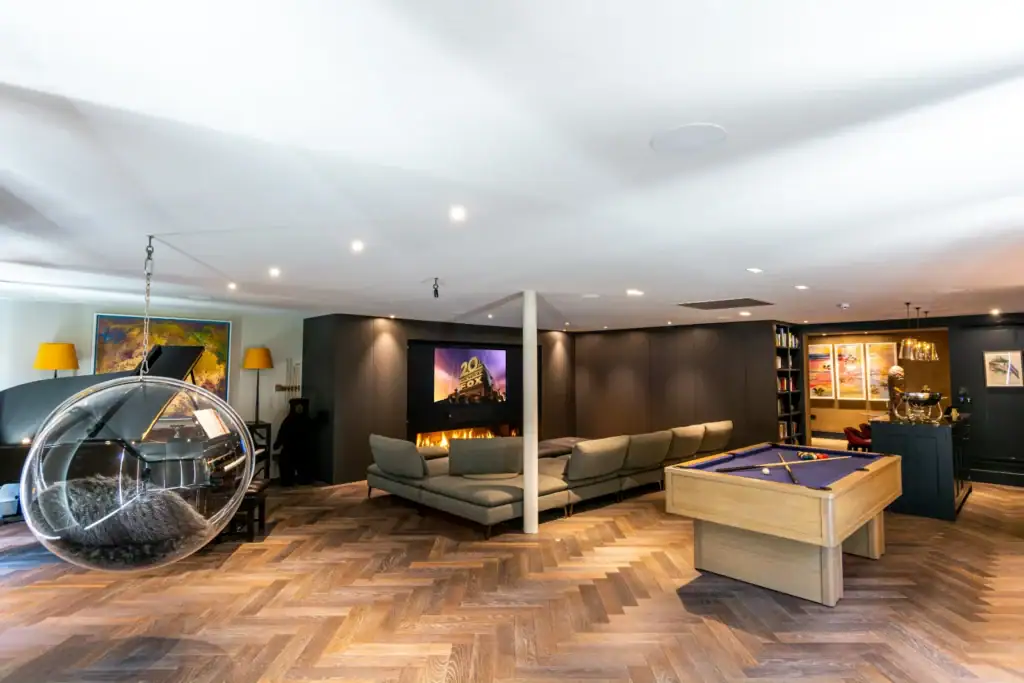
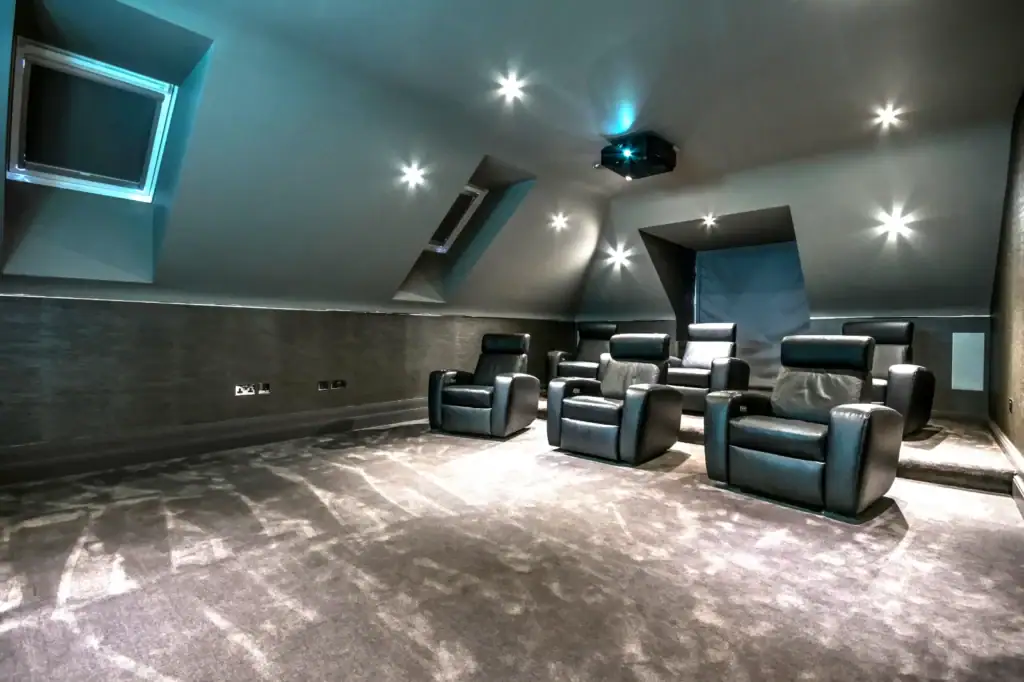
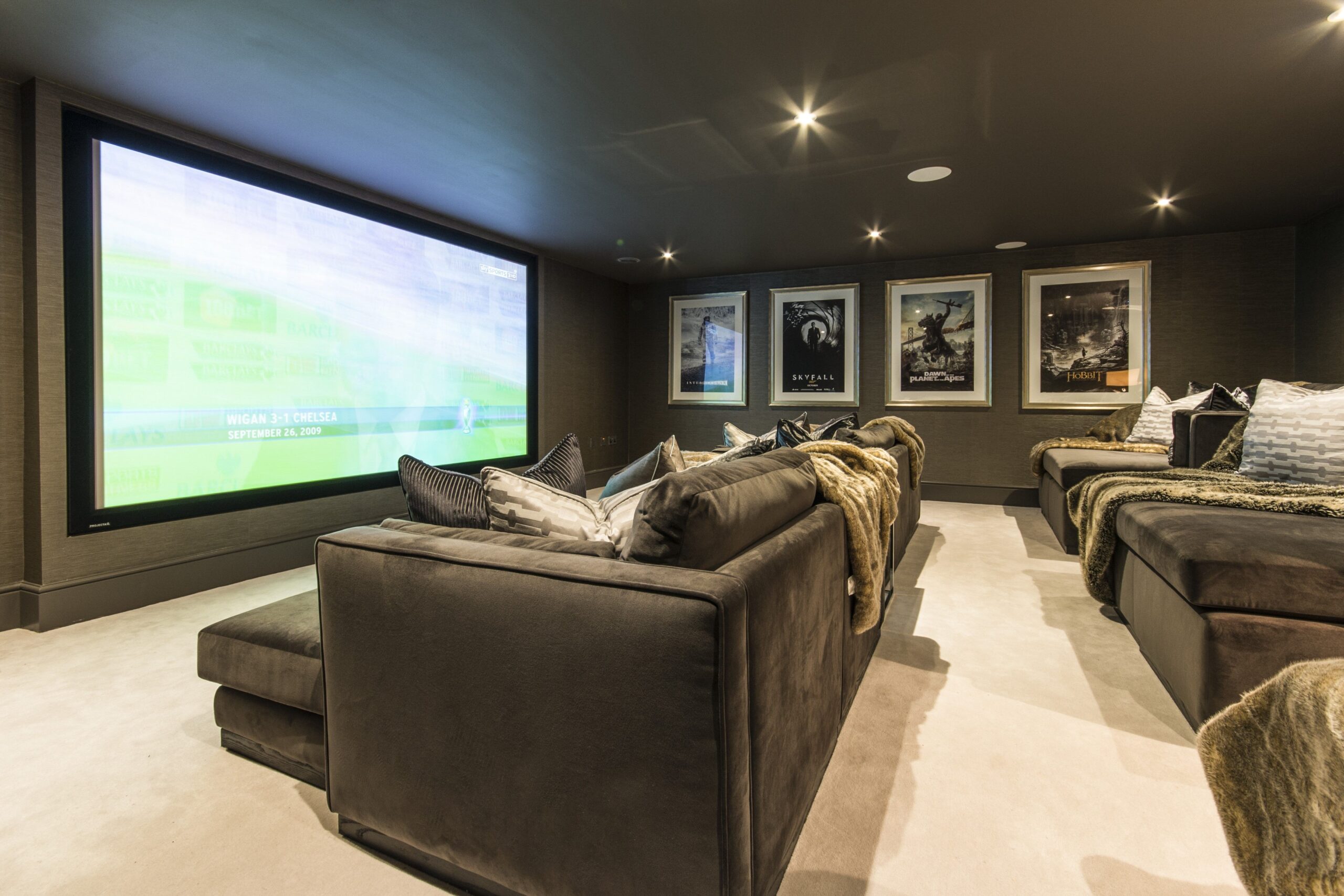
- How dark is the room? Draper points to its Performance White TecVision surfaces for fully darkened rooms, the conditions of a basement such as Weybridge.
- Is the room shared? Draper suggests Premium Contrast Grey for rooms that do several jobs but where light can still be managed, and the grey tint deepens blacks.
- Can the light be controlled at all? Where it cannot, Draper's ambient light rejecting surface turns away light arriving from off-axis. Draper lists it with a gain of 0.9 and an extra-wide viewing cone.
Gain describes how strongly a surface reflects light back towards the seats compared with a neutral white reference. Higher gain looks brighter in the centre but can narrow the angle at which the picture looks even, which matters with two rows of seats or a wide sofa. Projector brightness, screen width and gain are therefore chosen together, never one at a time.