The best kitchen lighting uses three layers: ambient light for the whole room, task light over worktops, the hob and the sink, and accent light for depth. Put each layer on its own dimmer circuit, then group them into scenes so cooking, dining and evening settings are one touch away.
What are the layers of kitchen lighting?
Most UK lighting guides, such as this one from Simple Lighting, describe the same three layers. Ambient lighting fills the room, task lighting is bright and shadow-free where you work, and accent lighting adds character. A kitchen that relies on a single bank of ceiling downlights tends to look flat, and it throws your own shadow across the worktop.
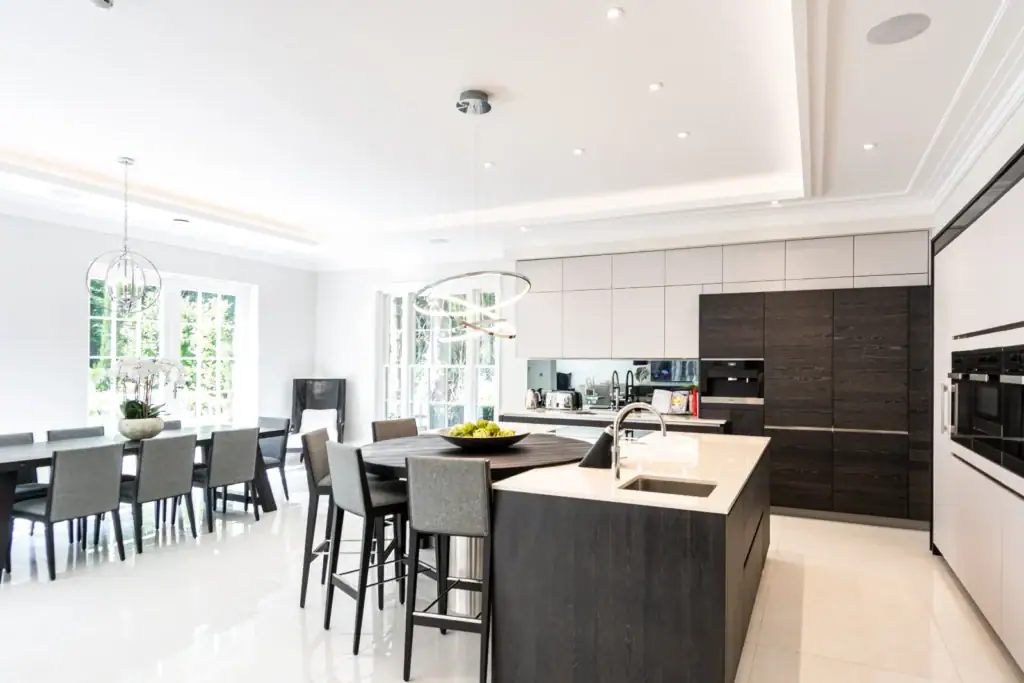
- Ambient: recessed downlights, ceiling fittings or track. This is the layer people usually get right, because it is what the electrician installs by default.
- Task: under-cabinet LED strip for the worktops, plus focused light over the island, sink and hob.
- Accent: light on shelving, glass-fronted cabinets, a plinth or a feature wall.
Why does each layer need its own control?
Layers only work if you can change them independently. If every light in the kitchen is on one switch, you have one brightness: either bright enough to chop onions or dim enough to eat dinner, never both. Separate circuits for each layer, each on a dimmer, give you the range. Our guide to planning lighting scenes room by room goes deeper on how to group them.
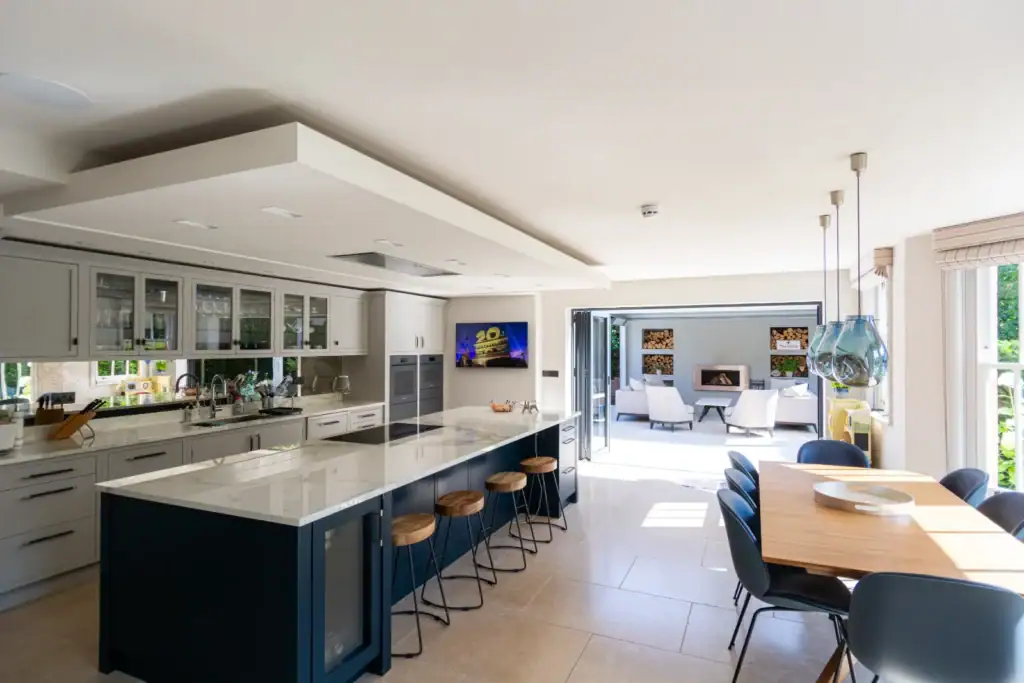
The same thinking applies to open-plan spaces, where the kitchen, dining and living areas share a room. Each zone should be dimmable on its own, so you can lower the kitchen worktops while the dining table stays lit.
Where should task lighting go?
Put it between you and the work. Downlights set in a grid often land directly behind you as you stand at the counter, which casts a shadow over what you are cutting. Under-cabinet strip lighting solves this because the light comes from above and in front of the worktop. Over an island, pendants or a row of focused spots work, but check that the glare is comfortable from seated height as well as standing.
Cooking zones need their own thought. Over the hob and the sink, aim for clear, bright light, and keep it on a separate circuit so you can raise it without lighting the rest of the room.
What does accent lighting add to a kitchen?
Accent light is what makes a kitchen feel designed rather than merely lit. Lighting inside glass cabinets, along a plinth or across a shelf adds depth in the evening, and at a low level it works as a night light for a late-night glass of water without switching on the main lights.
How do you control kitchen lighting in a smart home?
A lighting control system turns the layers into scenes. A typical kitchen might have a bright “Cooking” scene with task and ambient light high, a “Dining” scene with the ambient layer low and the accents on, and a “Night” scene with only a soft glow. With Lutron lighting control, those scenes sit on keypads by the kitchen door and can also be triggered from a Control4 smart home system, alongside blinds, music and the rest of the house.
For a wider view of what we design, see smart home lighting and shading. For a real example of lighting integrated into a whole-home system, read our Hampstead Control4 and Lutron lighting project.
What goes wrong with kitchen lighting?
- One circuit for everything: no layers, so no flexibility.
- Lights that flicker or buzz on dimmers: usually a mismatch between the LED fitting and the dimmer. We cover the causes in why LED lights flicker or buzz on a dimmer.
- Deciding too late: the circuits, cable routes and under-cabinet power all need to be settled before plastering and cabinet fitting. Retrofitting is possible, but it is easier and neater to plan first.
Frequently asked questions
How many lights does a kitchen need?
There is no fixed number. It depends on the size of the room, ceiling height and fittings. Plan by layer first, with ambient, task and accent, then choose the fittings for each.
Should kitchen lights be dimmable?
Yes. Dimming is what lets one kitchen serve for cooking, family meals and evenings. Make sure the fittings and dimmers are compatible.
Can I add smart lighting to an existing kitchen?
Often, yes. How easily depends on the existing wiring and fittings, so a survey is the best first step.
Is under-cabinet lighting worth it?
For task lighting, it is one of the most effective upgrades, because it lights the worktop without your shadow falling across it.
Planning a kitchen lighting scheme?
We design lighting as part of the wider home, and can show you how scenes and keypads work at our showroom. Visit our showroom in Walton-on-Thames or get in touch to talk through your project.