
Our Sony projector review in brief: Sony’s native 4K SXRD laser projectors are bright, sharp and very good with sport, games and films, which is why we have fitted them in family rooms in Walton-on-Thames and Fetcham. The drawbacks reviewers raise are price, limited HDR format support and, on some models, no 3D or motorised lens.
Last reviewed: 22 October 2026
How did Sony become a home cinema projector brand?
Sony was founded in Tokyo in 1946. Its home cinema projectors grew out of its professional work. When Sony launched the VPL-VW1000ES in 2011, Trusted Reviews noted it was derived from Sony’s commercial cinema 4K projectors, with three native 4096 by 2160 SXRD chips at a time when hardly any 4K films existed to show on it.
SXRD, short for Silicon X-tal Reflective Display, is Sony’s own panel technology, and it has stayed at the heart of the range. The current generation pairs it with a laser light source and processing borrowed from Sony’s BRAVIA televisions. There was a wobble in 2025: What Hi-Fi reported that Sony briefly stopped selling projectors in the UK and Europe before the problem was resolved and sales resumed.
This article looks at the brand as a whole. For how we plan a Sony room, including screens and light control, see our Sony projector and TV page.
What is Sony known for in home cinema?
Native 4K. Sony’s panels show 3,840 by 2,160 pixels directly, and What Hi-Fi notes the BRAVIA Projector 9 has no need to shift pixels the way many rival 4K models do. Sony is also known for brightness, smooth motion from its 4K Motionflow processing, and laser light sources that Sony rates at up to 20,000 hours, which ends lamp changes.
Sony’s UK professional site lists the BRAVIA Projector 9, 8 and 7, alongside the VPL-XW7000ES and VPL-XW5000ES, as current home cinema models (checked 14 October 2026). What Hi-Fi has given five stars to both the Projector 9 and the Projector 7, and called the Projector 7 a sublime home cinema projector.
Why do clients choose Sony?
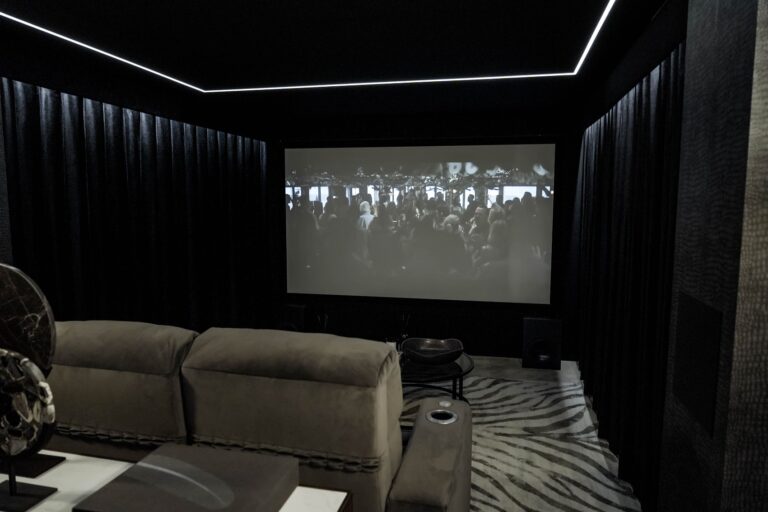
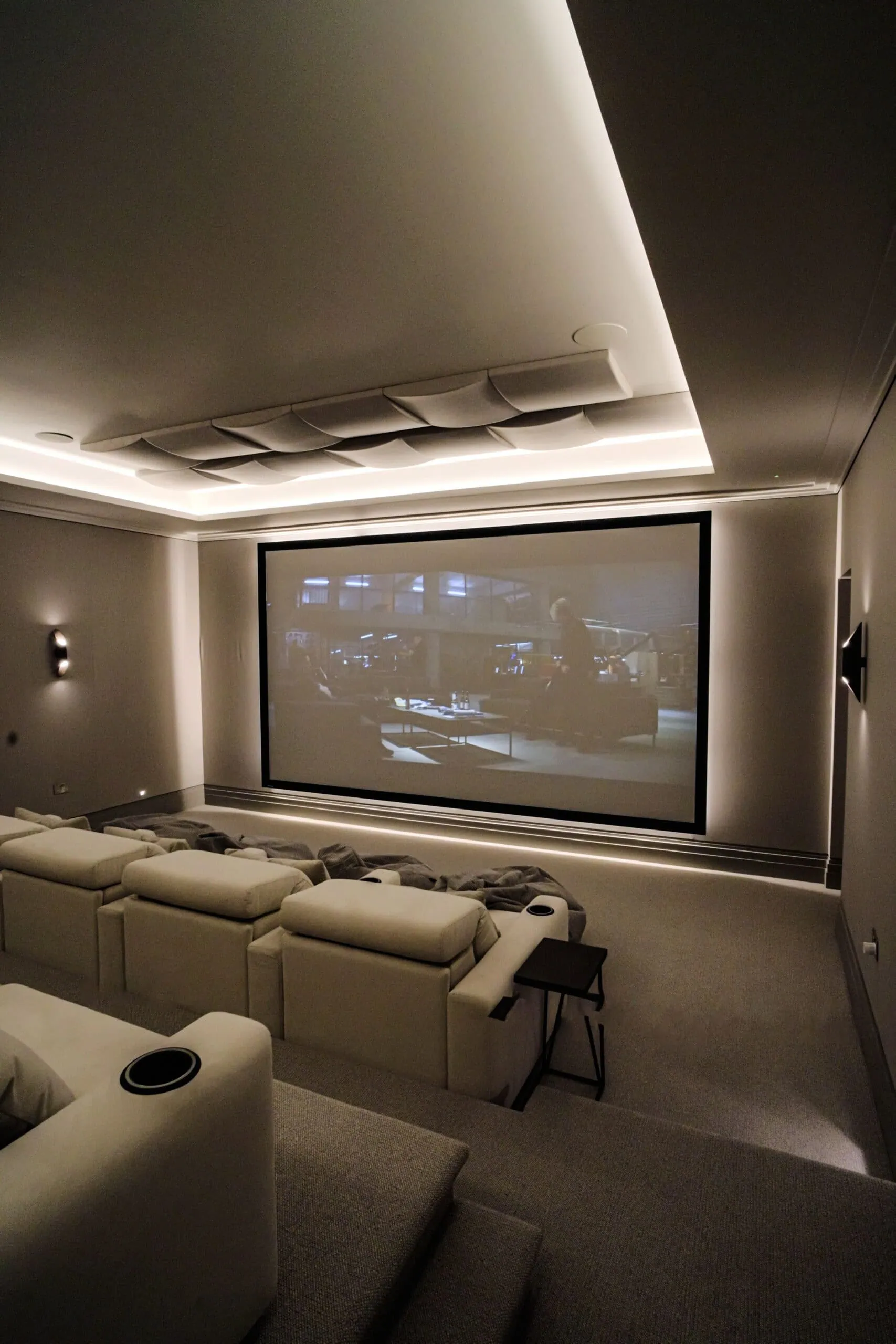
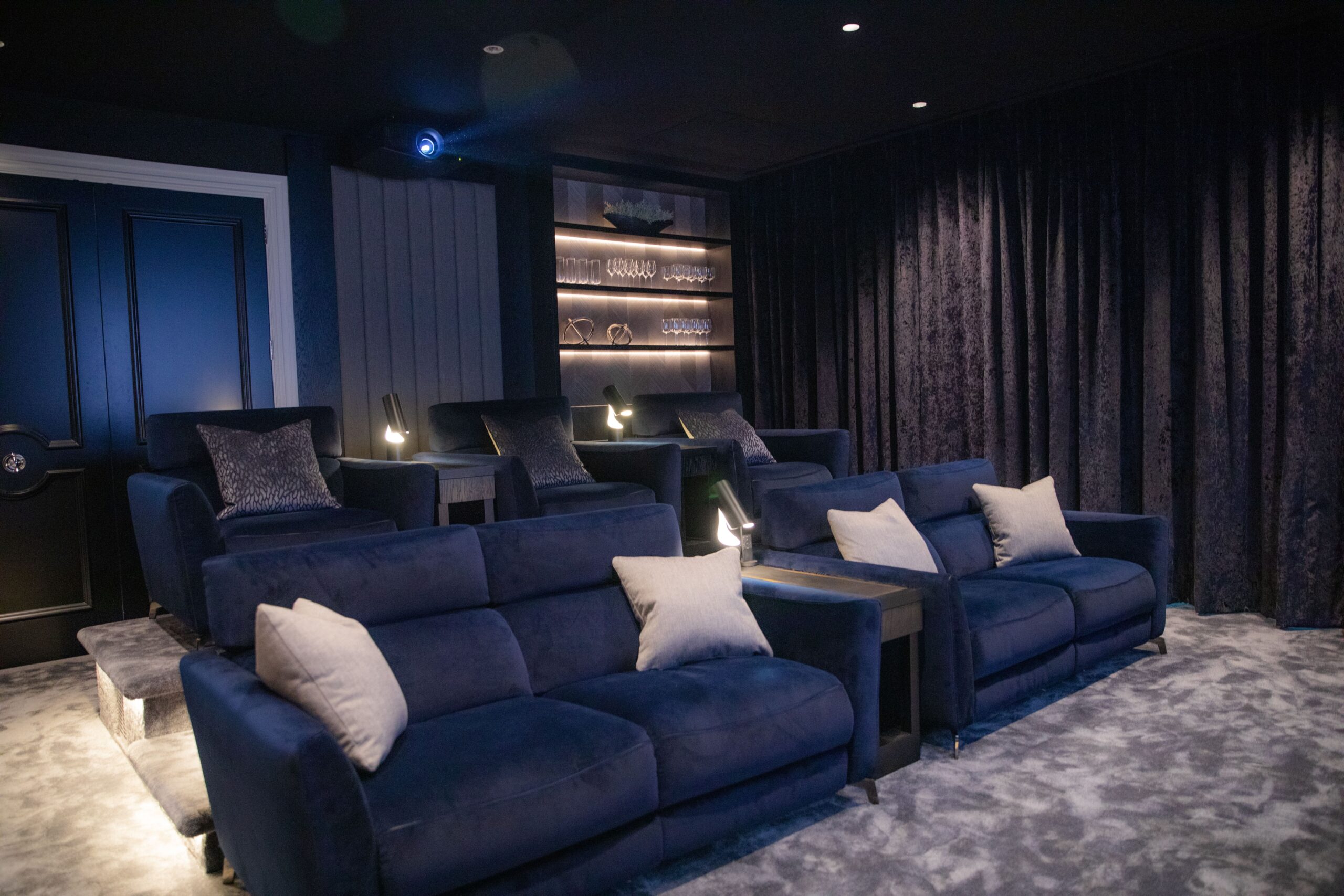
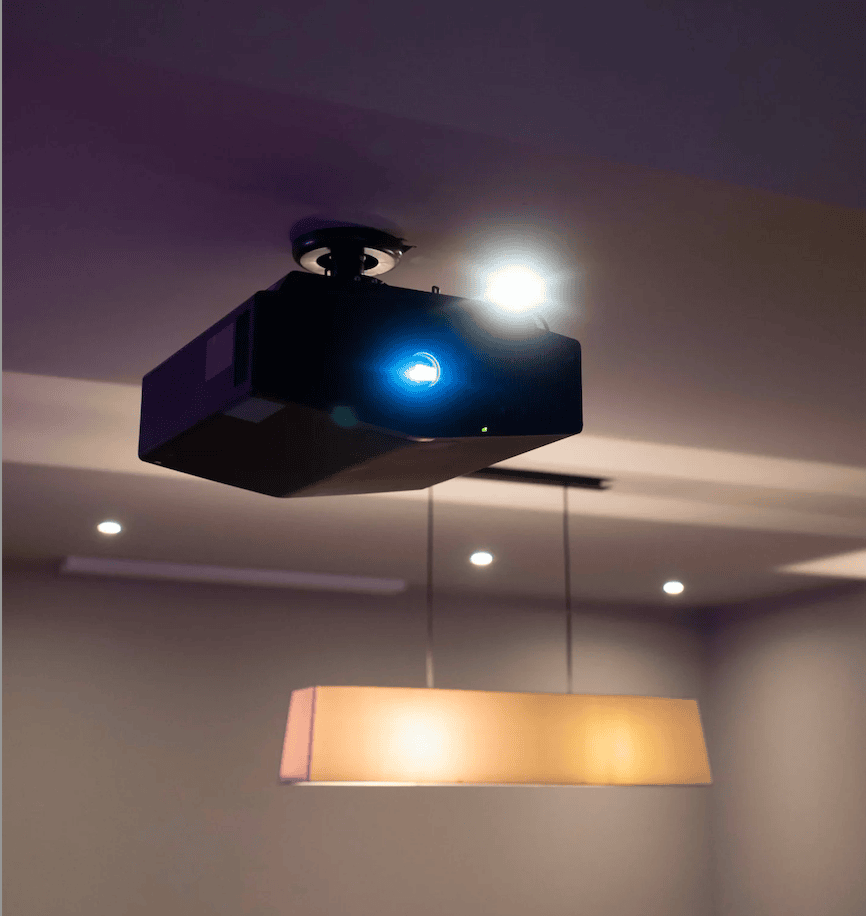
The rooms we have built with Sony share a brief: they are family spaces first. The Walton-on-Thames media room was a sports room first; the new brief added family films and evenings with friends. Its old projector gave way to a Sony 4K laser model with a sharper, clearer picture. In Fetcham, a Sony XW-5000 4K laser projector lights a 126 inch screen from Projecta that lets sound through, in a room with a bar and a pool table, where the teenagers wanted somewhere to game with friends.
Sony suits that kind of room because it is bright enough to give HDR real punch, and Sony says its processing reduces blur in fast action and upscales lower resolution sources, which matters for HD football on a big screen. A laser light source also means no lamp changes once the projector is up on the ceiling.
What are the pros and cons of a Sony projector?
| Pros | Cons |
|---|---|
| Native 4K SXRD panels, with no pixel shifting | Expensive, and What Hi-Fi calls the Projector 9 exceptionally expensive |
| High brightness for punchy HDR | On the Projector 9, very bright highlights can lift black levels in dark scenes |
| Processing drawn from Sony’s BRAVIA TVs | No Dolby Vision or 3D on the Projector 9, and What Hi-Fi wished the Projector 7 had HDR10+ or Dolby Vision |
| Long-life laser light, so no lamps to buy | The Projector 7 keeps manual lens controls, which What Hi-Fi lists among its cons |
| Good with sport and games, with 4K at 120Hz on the Projector 7 and the Projector 9 | UK supply was interrupted in 2025, so check availability early in a project |
One more honest point: brightness is not a cure for daylight. What Hi-Fi says a projector as bright as the Projector 9 should still go in a room that is almost as dark as a commercial cinema, and we agree.
Who suits a Sony projector, and who does not?
Sony suits a room that has to do several jobs: Saturday football, a family film, a games night with friends. It suits people who want a bright, sharp, low-maintenance picture on a big screen without fuss. Our media room design work is often built around exactly this mix.
It suits less well if your collection depends on Dolby Vision or 3D discs, or if the room has large windows that can never be blacked out. In that case, read our projector or TV guide before deciding.
How does a Sony projector fit a Control4 and Lutron home?
In our projects the Sony is one part of a room that starts from one button. Walton-on-Thames is run from one handset or a phone app: Control4 looks after the AV kit, the room temperature and the Lutron HomeWorks lighting, while Silent Gliss blackout blinds handle the windows. The family no longer hunts for the right remote. In Fetcham, Control4 gives the family a single touch point, and the room was designed with several lighting modes so the bar can stay lit while the screen end goes dark.
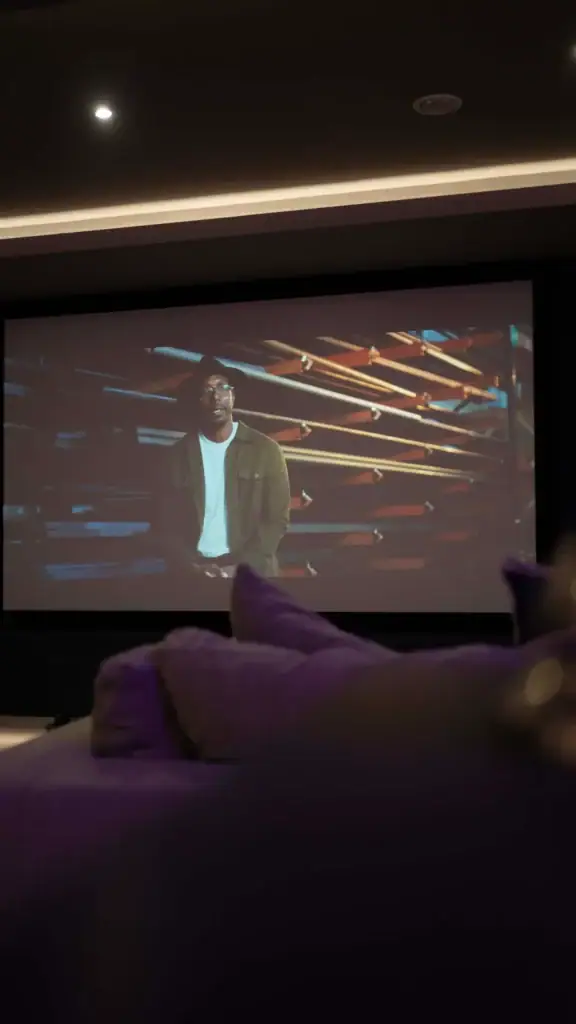
As a Platinum Control4 dealer, our focus is the routine: the projector warming up as the lights dim, and the room returning to normal at the end. Blackout matters as much as the projector, so our motorised blinds and shading work usually comes into the same design. You can see a Sony 4K laser projector on a 2.8 metre screen in our Walton-on-Thames showroom.
Frequently asked questions
Is Sony still selling projectors in the UK?
Yes. What Hi-Fi reported in October 2025 that UK sales had resumed after a short pause, and Sony’s UK professional site lists the BRAVIA Projector 9, 8 and 7 among its current home cinema models (checked 14 October 2026).
What does SXRD mean?
SXRD stands for Silicon X-tal Reflective Display. It is Sony’s own reflective panel technology, used in its home cinema projectors, each panel with 3,840 by 2,160 native pixels.
When did Sony start making native 4K home projectors?
By 2011. Trusted Reviews reviewed the VPL-VW1000ES that December: a home cinema projector with three native 4096 by 2160 SXRD chips, launched when there were hardly any 4K films to watch on it.
How heavy is a Sony home cinema projector?
What Hi-Fi gives the BRAVIA Projector 7 as 13kg and the Projector 9 as 14kg. Either needs a solid ceiling fixing, which we plan with the ceiling build rather than after it.