The best place for a subwoofer in a home cinema is found by ear, not by rule. Put the sub at your main seat, play steady bass, then crawl around the room to find where bass sounds tightest. Place the sub there. Add a second sub only to even out bass across several seats.
Why does subwoofer placement matter so much?
Low frequencies behave differently from everything else in a cinema system. In a closed room, bass builds up in some places and cancels out in others, so the same subwoofer can sound thunderous in one seat and thin in the next. Where the sub sits decides which of those patterns you hear at your seats.
That is why two identical systems can sound completely different. It is also why we treat the sub as part of the room design rather than a box to tuck beside the TV. If you are still planning the space, our guide to home cinema room layout covers where the seating and screen should go first, because the sub placement follows from them.
How does the subwoofer crawl work?
The crawl is the most widely recommended starting point. Audioholics describes it as crude but effective, and Monitor Audio and others describe the same basic idea: swap the positions of your ears and the speaker.
- Temporarily put the subwoofer in your main listening seat.
- Play a track with steady, repeating bass.
- Move around the room with your head near knee height, listening for where the bass sounds tightest and most balanced.
- Put the subwoofer in that spot and move your seat back.
It works because of reciprocity: the spot that sounds best to your ears with the sub in your seat is a good place for the sub when you are sitting there. Treat it as a starting point rather than a final answer, and fine-tune by ear afterwards.
Are corners a good place for a subwoofer?
Sometimes. Sound & Vision notes that corner placement can produce boomy, muddy bass, and other guides advise trying a corner first because it excites all of the room’s modes, which reduces the chance of deep dead spots. Both can be true in different rooms.
If a corner sounds boomy or indistinct, pull the sub a foot or two away from the walls, or slide it along the front or side wall and listen again. Equally, do not assume the front wall is the only option. In a room where the seating, the equipment cupboard and the cabling make the ideal spot awkward, the answer is usually a compromise that is planned early, which is far easier before the walls are closed up.
Do you need more than one subwoofer?
For one seat, a single well-placed sub is often enough. For a room with two or three rows, a second sub can make the bass more even across the seats, because each sub excites the room differently and the two partly fill in each other’s weak spots.
Common layouts for two subs include opposite ends of the front wall, opposing side walls, or diagonally opposite corners. For rectangular, symmetrical rooms, Audioholics also mentions the Welti-Devantier approach, which uses symmetrical positions such as opposing corners and wall midpoints. You can repeat the crawl for each sub, then adjust level, phase and delay so they work together rather than against each other.
What if the room itself is the problem?
Placement can only do so much. Sound & Vision warns that a corner position can create boom and muddiness that is hard to cure for more than one seating position when the room’s modes are spread out. In that case treatment helps: bass traps, sensible wall construction and a sound system that is calibrated once everything is installed. Our guide to acoustic treatment versus soundproofing explains what each one does.
Dolby Atmos systems add height speakers, but the sub is still the foundation, and the same placement logic applies. See what 5.1.2, 7.1.4 and 9.2.6 mean for how the rest of the speakers fit around it.
How do we handle subwoofers in a cinema design?
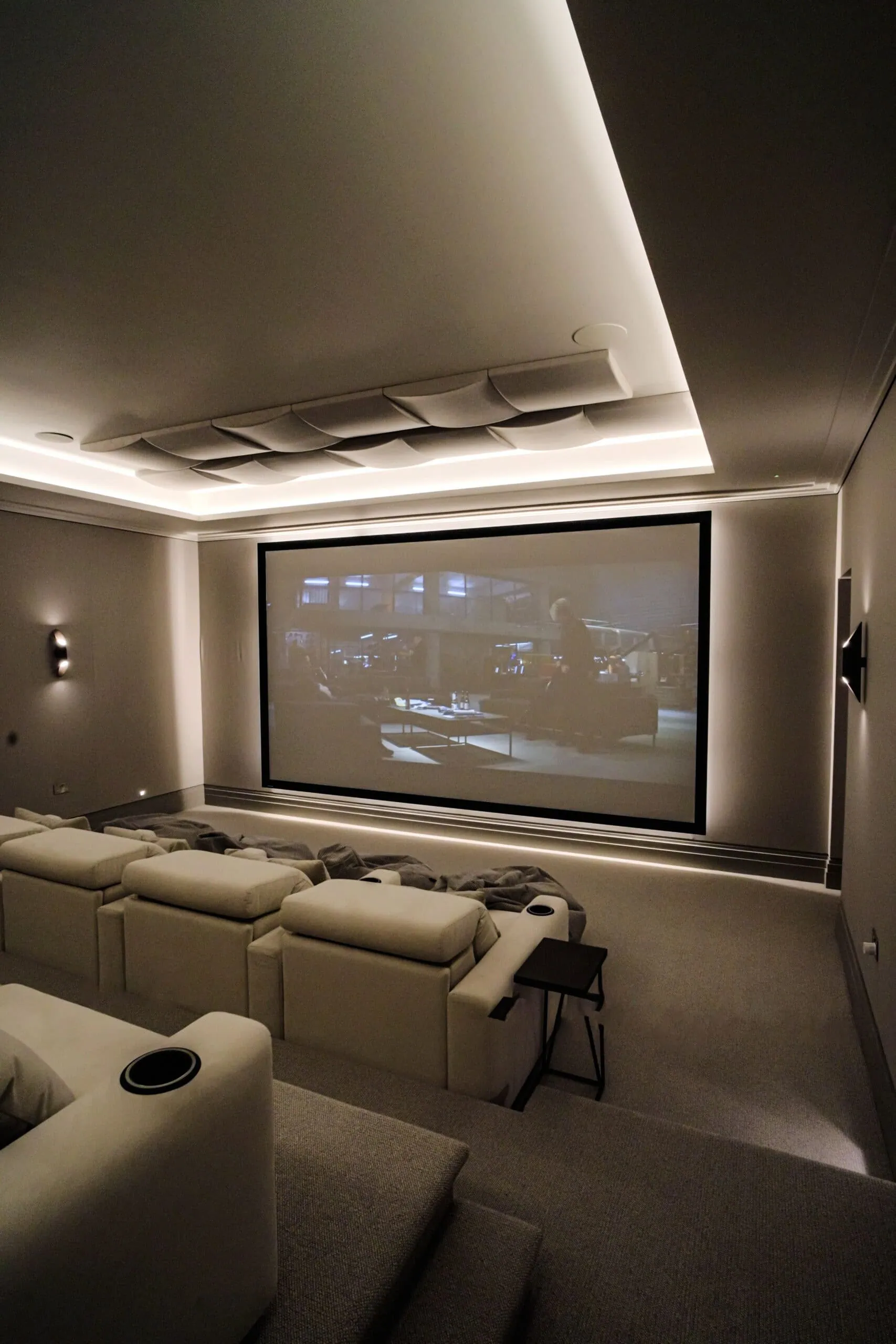
We decide sub positions during the design stage, alongside the seating, screen and cable routes, so that the room is built around the answer rather than working around it afterwards. That is part of our luxury home cinema and media room work, and the same thinking went into projects such as the basement cinema in Roehampton Gate.
Art of Integration was founded in 2012 and we run a demonstration cinema at our showroom in Walton-on-Thames, so you can hear a calibrated system rather than guess from a spec sheet. You can visit our home cinema showroom, or get in touch or call 020 3397 9888 to talk through your room.
Frequently asked questions
Where should a subwoofer go in a small cinema room?
Start with the crawl method. In small rooms, the front corners and the middle of the front wall are common candidates, but the best spot depends on the room. Try each and keep the one that sounds tightest at your main seat.
Is a corner always best for a subwoofer?
No. Corners can give strong, even bass, but they can also make it boomy. Pulling the sub a short distance from the walls or moving it along a wall often fixes it.
Do I need two subwoofers?
Not for a single seat. For several seats or rows, two subs in symmetrical positions can make the bass more even, provided they are set up together.
Can I fix bad bass with settings alone?
Level, phase, delay and room correction can improve a lot, but they work best once the sub is in a sensible position. Poor placement and an untreated room limit what settings can do.
Should the subwoofer be hidden or built in?
It can be, but plan it early. Hiding a sub in joinery can change how it sounds, so we agree its position and ventilation at the design stage.