Acoustic treatment controls how sound behaves inside your cinema room, so dialogue is clear and bass is even. Soundproofing, properly called sound insulation, stops sound passing between the cinema and the rest of your home. Acoustic panels do the first job, not the second. Most rooms need treatment; whether you need insulation depends on what is next door.
What is the difference between acoustic treatment and soundproofing?
The Building Regulations guidance on sound in England, Approved Document E, gives clear definitions in its glossary. Absorption is the conversion of sound energy into heat, often by a porous material. Airborne sound insulation reduces the transmission of sound through the air between buildings or parts of buildings. Impact sound insulation deals with sound from something striking the structure, such as footsteps on a floor.
Put simply, treatment is about the sound you want to hear, and insulation is about the sound you do not want to share. A room can sound superb and still keep the house awake. It can also be silent to the neighbours and sound harsh inside.
What does acoustic treatment actually do?
Every hard surface reflects sound. In a small room those reflections blur the sound from the speakers: smaller rooms exaggerate bass and reflect mid-range frequencies, which makes dialogue harder to follow and music feel cluttered. Treatment uses two tools to fix that.
- Absorption takes energy out of a reflection. Approved Document E rates absorbers with an absorption coefficient between zero, for a fully reflective surface, and one, for a fully absorptive surface. In a cinema, fabric-covered panels at the first reflection points, the places on the side walls and ceiling where sound bounces once on its way to your seat, are where treatment usually starts.
- Diffusion scatters a reflection into many weaker ones instead of removing it. The Home Acoustics Alliance describes the effect as adding spaciousness, and suggests diffusers usually belong in the rear half of a home cinema, between the surround and rear speakers.
Dolby’s own home cinema installation guidelines recommend both, using sound-absorbing and sound-diffusing treatment to handle reflections from the walls, floor and ceiling. Approved Document E also defines reverberation time, a useful measure of how lively a room is: the time taken for sound to die away by 60 dB after the source stops.
Bass needs its own attention. In a small room, a couple of bass traps in the corners is one of the upgrades we rate as worth the money, and in bigger rooms subwoofer placement does a lot of the work. At our Roehampton Gate basement cinema, four subwoofers were positioned and tuned with room-analysis software to remove bass dead zones, behind fabric-wrapped wall panels that hide the treatment.

What does soundproofing involve?
Sound insulation is building work, not decoration. Approved Document E explains that how much sound a wall stops depends on its mass, on isolation, which it defines as the absence of rigid connections between parts of a structure, and, in framed walls, on absorbent material in the cavity. It also names two ways sound gets round a good wall:
- Air paths: any direct or indirect air passage from one side of a structure to the other, from a door without seals to a gap round a cable entry.
- Flanking transmission: sound travelling through the floor, ceiling or side walls instead of directly through the wall between the rooms.
In practice, insulating a cinema means heavier layered linings, independent walls or ceilings with no rigid links to the structure, floating floors on a resilient layer, sealed doors, and ventilation designed so it does not become an air path. A sealed room still needs fresh air.
All of this is far easier to plan than to retrofit. Cable routes, riser dimensions and acoustic allowances are cheap on paper and expensive after plastering, so if you are building or renovating, involve your AV designer at drawing stage.
What do the Building Regulations require?
Less than many people expect. Requirement E2 in Approved Document E covers new internal walls between a bedroom or a room containing a WC and other rooms, and new internal floors, in homes. The minimum laboratory airborne sound insulation for those walls and floors is 40 dB Rw. E2 does not apply to an internal wall that contains a door, or to existing walls and floors in a building undergoing a material change of use.
That 40 dB figure is a baseline for everyday privacy between rooms. In our view it is not a target for a cinema playing a film at full volume below a child’s bedroom. If quiet next door matters, the insulation should be designed as part of the room, with specialist acoustic input where the construction calls for it.
Which does your room need?
- Treatment: we recommend it in almost every dedicated room, and it can be subtle. In our Oxshott cinema, treatment was worked in quietly to improve clarity and reduce echo, especially for dialogue-heavy scenes.
- Open-plan rooms need treatment even more. In our Esher entertainment room, open-plan acoustics were the main challenge, so treatment was designed for the open volume alongside a KEF THX 5.2.2 system.
- Rooms with a clarity problem: the family in our Epsom media room had poor sound clarity, and acoustic panelling was a key part of the fix.
- Insulation: when the cinema shares a floor, ceiling or wall with bedrooms or a neighbour, or when outside noise would spoil a quiet scene. A basement already sits apart from the rest of the house, which helps; our guide to basement cinema rooms covers what else to plan.
Does acoustic treatment have to look like a studio?
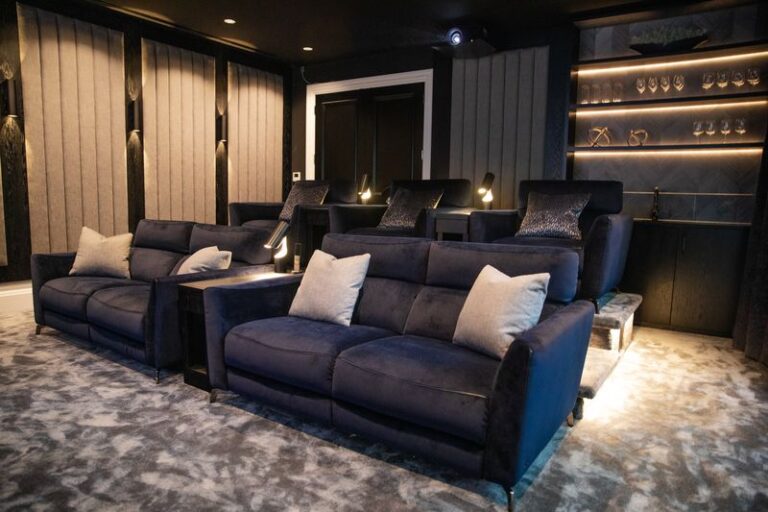
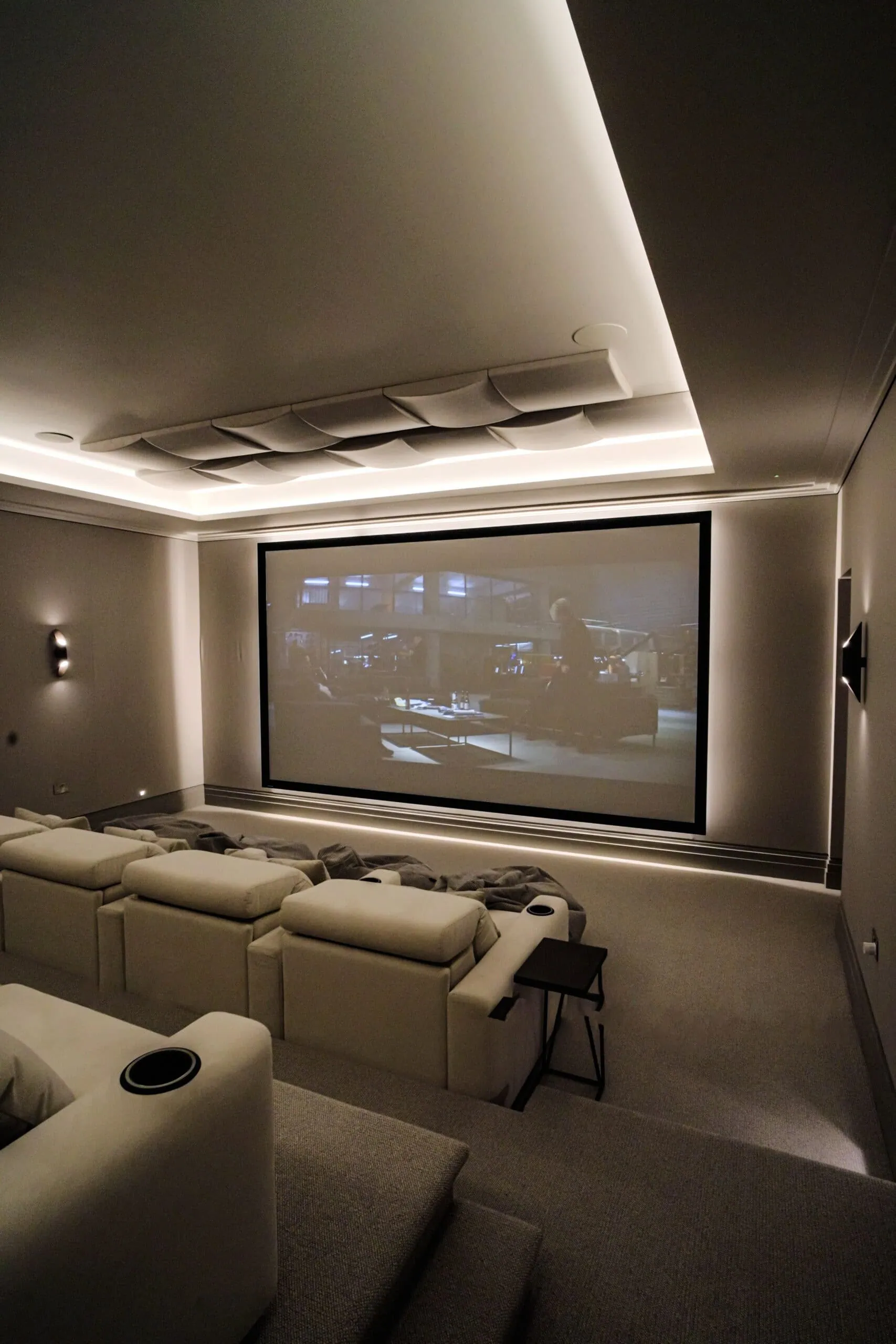
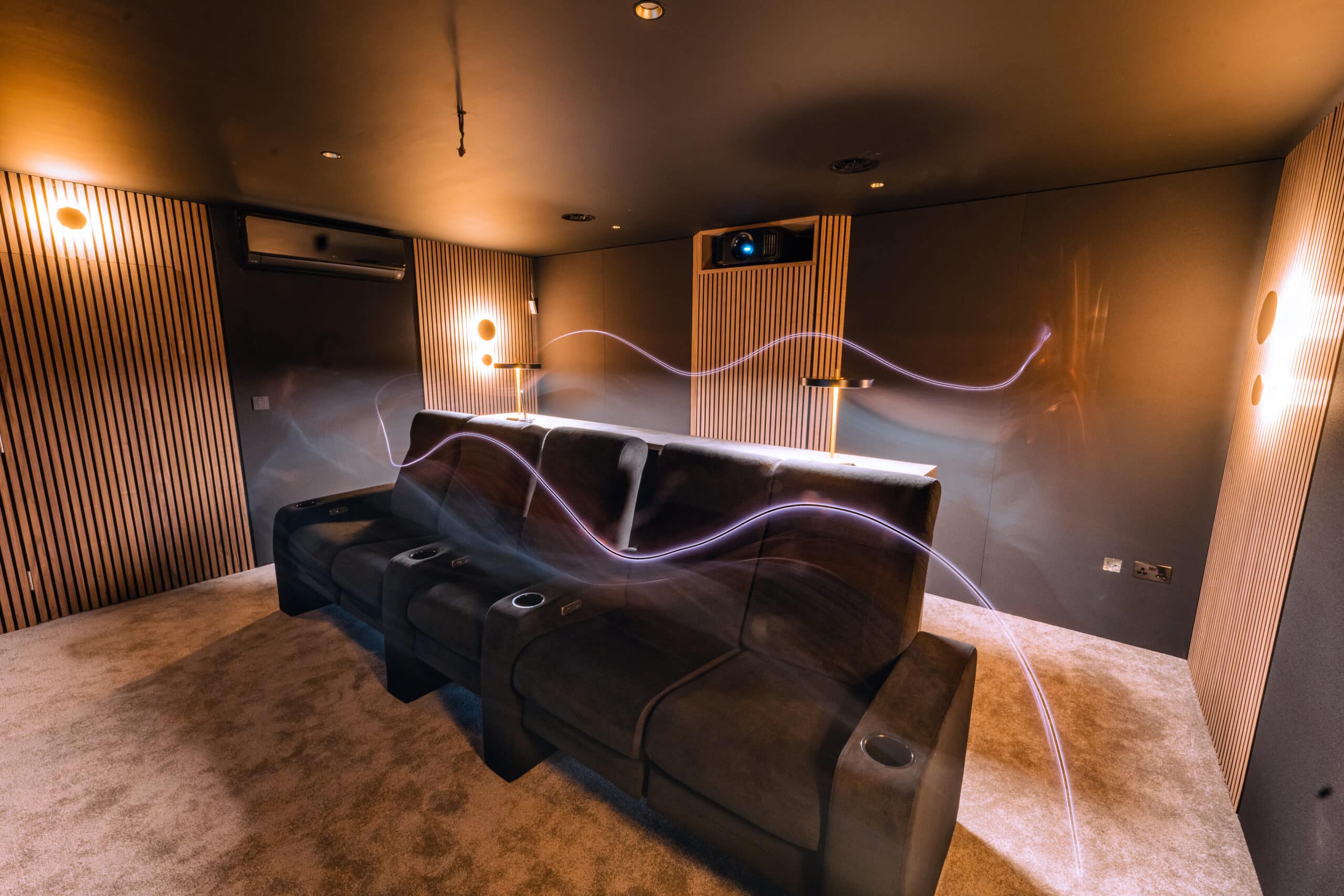
No. We work with interior designers to hide treatment behind discreet ceiling panels or fabric walling systems. In our Walton-on-Thames media room renovation, acoustic wall treatment sits within designed wall and ceiling panels, and black fabric on the ceiling screens the speakers from view. At Roehampton Gate, a bespoke fabric-panel system hides the speakers, cabling and treatment together.
Treatment and speaker layout work as a pair, so it is worth reading our guide to Dolby Atmos speaker layouts alongside this one. For the full picture of how we design and build a room, see our luxury home cinema service.
Acoustics are easier to hear than to describe. Come and sit in our Walton-on-Thames demonstration cinema and hear what a treated room sounds like. Book a showroom visit.
Frequently asked questions
Do acoustic panels soundproof a room?
No. Acoustic panels absorb reflections inside the room, which improves clarity, but they are not a substitute for sound insulation, which depends on mass, isolation and airtight construction.
What is the difference between absorption and diffusion?
Absorption takes energy out of a reflection, while diffusion scatters it into many weaker reflections. Absorbers usually go at the first reflection points, and the Home Acoustics Alliance suggests diffusers in the rear half of a home cinema.
Is acoustic foam good enough for a home cinema?
For a small cinema room we recommend fabric-covered panels rather than foam, plus a couple of bass traps in the corners. Better acoustic treatment is one of the few upgrades we single out as worth the extra spend.
Do the Building Regulations say how soundproof a cinema room must be?
Not specifically. Approved Document E sets a minimum of 40 dB Rw for new internal walls around bedrooms and WCs and for new internal floors in homes, which is a baseline for privacy rather than a cinema target.
Do I need acoustic treatment in a small room?
Yes, arguably more than in a large room. Small rooms exaggerate bass and reflect mid-range frequencies, which makes dialogue harder to follow, so a modest amount of well-placed treatment makes a big difference.