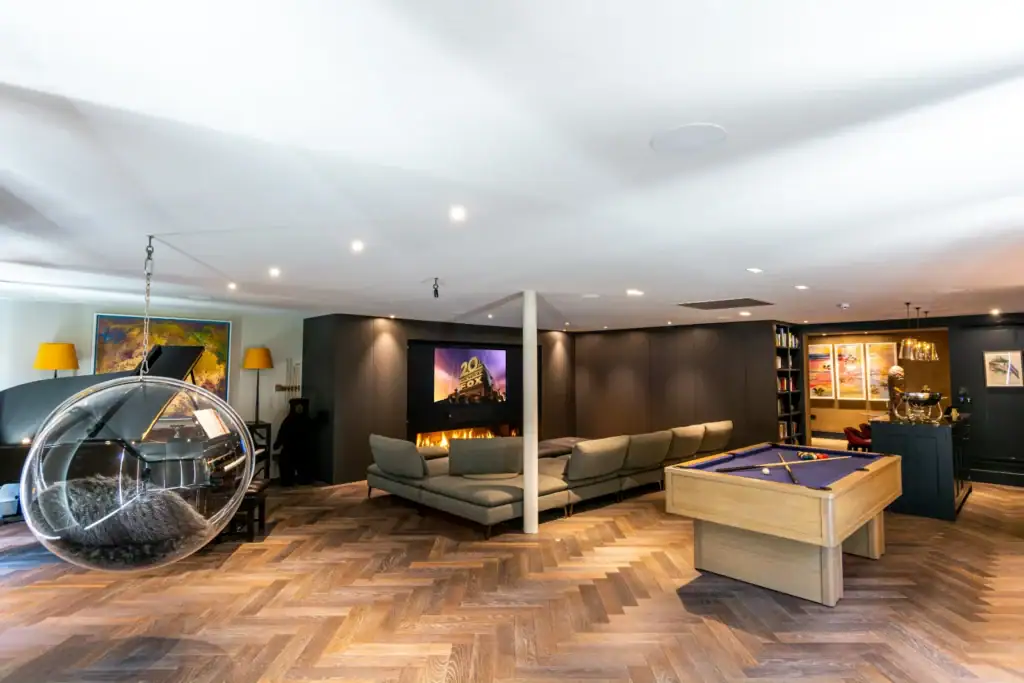
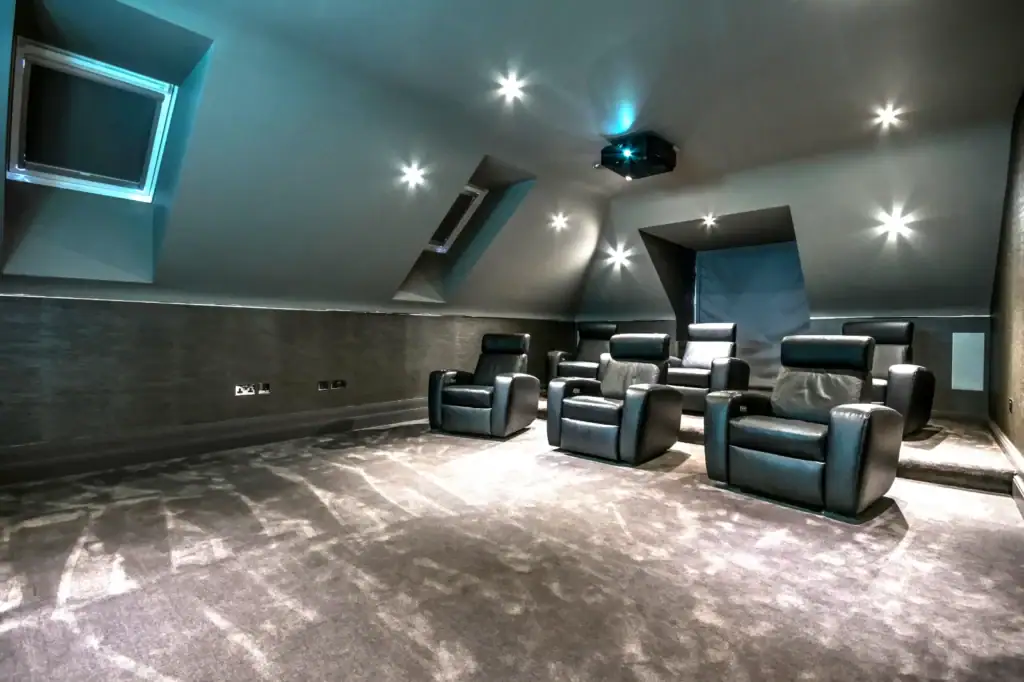
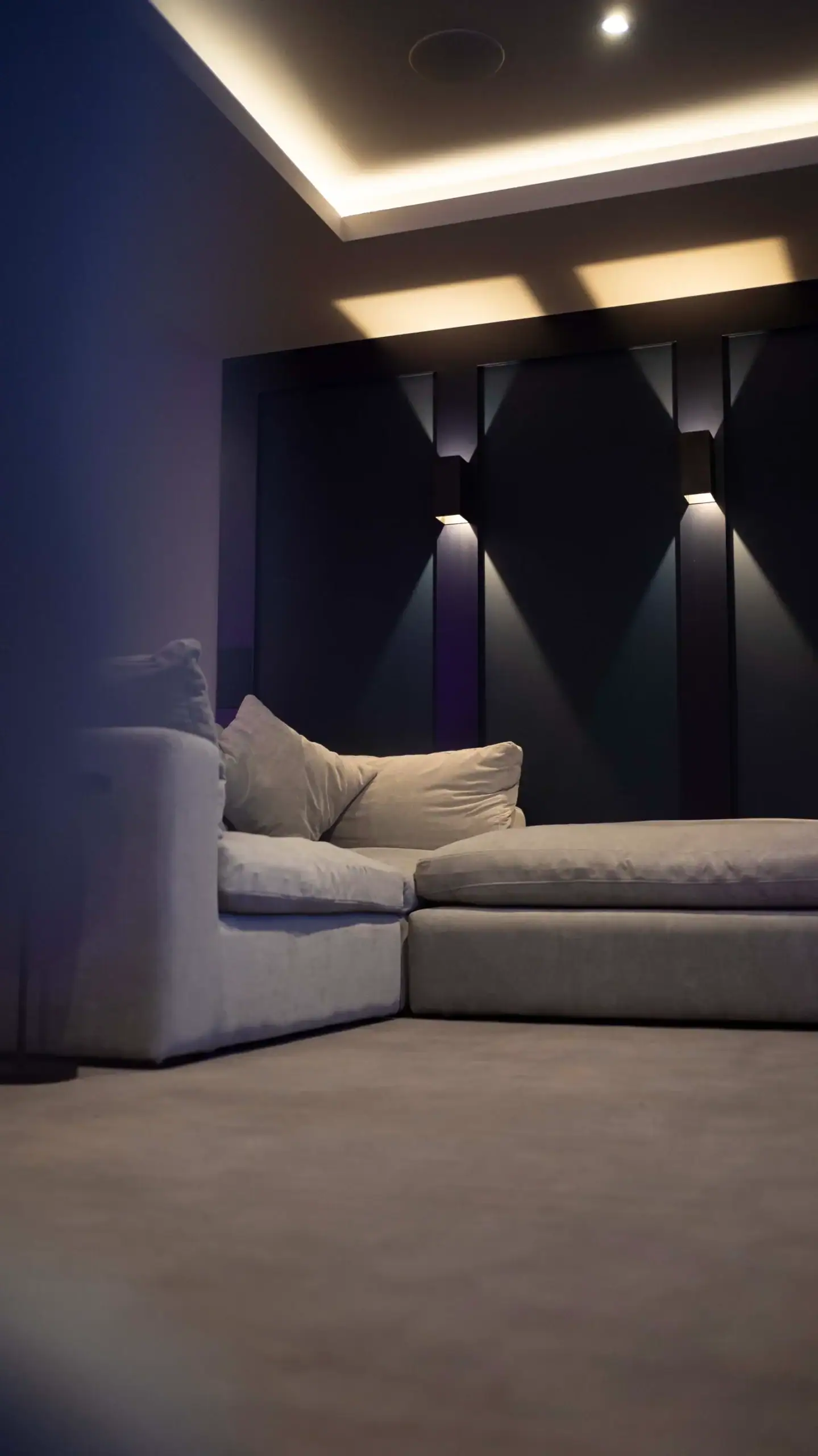
Architectural audio integration and support by Art of Integration

Artcoustic Control4 integration and support for Surrey and London homes

Artcoustic is a Danish loudspeaker maker based in Copenhagen and founded in 1998, whose slim on-wall speakers carry front screens in a painted colour or a printed artwork, so they hang like pictures. We can help owners and buyers plan Artcoustic around a Control4 smart home and Lutron lighting, and support systems already on the wall.

Since 2012Showroom in Walton-on-Thames★ 5.0 on Google
Best for

Finished rooms where speakers must sit on the wall without cutting plaster, and where the interior designer wants them to read as artwork

Works with

A suitable amplifier or AV processor; Artcoustic says its SL C-2/Stereo soundbar can run from a Control4 audio zone

Where to see it

Artcoustic's UK training facility and showroom in Chelmsford, Essex, and the online Art Gallery of screen designs

How we help

Planning around Control4 and Lutron, amplifier and subwoofer advice, and support for Artcoustic systems you already own

Official website: Artcoustic (opens in a new tab)

artcoustic control4artcoustic control4artcoustic control4
Overview
artcoustic control4Photo: Linsy Raaffels, CC BY-SA 4.0, via Wikimedia Commons
01

What are Artcoustic speakers?

Artcoustic was started in 1998 by two Danes, Kim Donvig and Patricia Ljungberg, who wanted to know why serious loudspeakers could not look as good as they sound. The company is based in Copenhagen, says its speakers are hand-built in Europe, and sells them in more than 35 countries. Its answer is a slim cabinet with a removable front screen, and almost every Artcoustic range is built around that idea.

The current line-up falls into four series:

  • SL Series: slim on-wall speakers in many sizes, from the small SL Mikro to tall Evolve arrays, plus the SL soundbars and the shallow SL Architect models for ceilings and walls.
  • Spitfire Series: line-array speakers aimed at dedicated cinemas, including the Spitfire Q models and the Spitfire Cloud, an overhead speaker on an angled baffle for Dolby Atmos height effects.
  • CPH Series: all-round speakers for wall or stand, with active versions, Bluetooth and optional Wi-Fi.
  • Subwoofer Series: bandpass subwoofers that take deep bass away from the slim main speakers.

A small outdoor range completes it. The SL Evolve 1 IP and Evolve 1 Array IP are sealed, IP66-rated versions that fix to an outdoor bracket or a ground spike in a lawn or planting bed.

artcoustic control4Photo: Linsy Raaffels, CC BY-SA 4.0, via Wikimedia Commons
02

Why choose a speaker that hangs like a picture?

With most architectural speakers the aim is to disappear. Artcoustic takes the opposite route: the speaker stays on the wall and its front becomes a design surface. Cabinets can be painted in NCS or RAL colours, and the screen can match the wall, match the cabinet or carry a digitally printed image. That image can come from the Artcoustic Art Gallery, where invited artists create exclusive designs, or from a picture the owner supplies. Screens fix magnetically and can be swapped later, so a pair of speakers can change with the decoration.

That suits houses where cutting into walls is unwelcome: a drawing room that has just been redecorated, a newly finished London apartment, or a listed interior where a picture hook is easier to justify than a chased channel. It also suits owners who want real output from a cabinet only a few centimetres deep. Artcoustic builds for high sensitivity, so its speakers reach cinema volume from modest amplifier power, and it hands deep bass to separate subwoofers so the slim cabinets do not have to produce it.

The trade-off is plain: these are visible objects. If the brief is a bare wall with nothing on it, an invisible speaker is the better tool.

artcoustic control4Photo: Shixart1985, CC BY 2.0, via Wikimedia Commons
03

Planning Artcoustic: colour codes, bass and future screens

  • Specify colours in Artcoustic's own systems. SL and CPH cabinets are made to RAL Classic, NCS 1950 or NCS 2050 references, and Artcoustic asks for paint-brand codes to be converted to one of these first. It also warns that one colour can look different on a wall, a cabinet and a fabric screen, so we would ask for a sample before committing a whole room.
  • Size by distance, not by look. Artcoustic suggests compact models for close listening and larger enclosures or line arrays where the seats sit further back. Its free Audio Analysis Service can model a room before anything is ordered.
  • Budget the subwoofer from the start. The slim cabinets are designed to pass bass to a subwoofer, and Artcoustic recommends one for films, especially in larger rooms.
  • Plan the ceiling for Atmos. Artcoustic speakers are included in Dolby's Atmos Room Design Tool, and the Spitfire Cloud and SL Architect models give overhead options. The Dolby Atmos layouts guide shows where overhead speakers would go.
  • Allow for change. Screens are interchangeable, so a client who redecorates later can replace the artwork instead of the speakers. Recording each model and screen size at handover makes that simple.
Our approach

How we would approach Artcoustic in your home

Because Artcoustic speakers are part of the decoration, we would plan them alongside whoever is hanging the art, not after them. A typical sequence:

  • Start with the wall elevations. We would mark which frames on the hanging plan are speakers and which are paintings, keeping the left and right speakers at matching heights and distances from the seats so the stereo image holds together.
  • Choose the image with the designer. The printed screen is the part everyone looks at, so the interior designer would sign off the artwork or colour, and we would check the speaker size suits both the wall and the listening distance.
  • Hide the cable. On-wall speakers still need wiring. In a room being redecorated we would run it inside the wall to the exact hanging point; in a finished room we would look at skirting, joinery and the backs of furniture first.
  • Find homes for the subwoofer and amplifier. Artcoustic's sub-satellite design relies on a subwoofer for bass, so we would hide it in joinery or behind a sofa, and keep the amplifier in the equipment rack as one zone of a multi-room AV system.

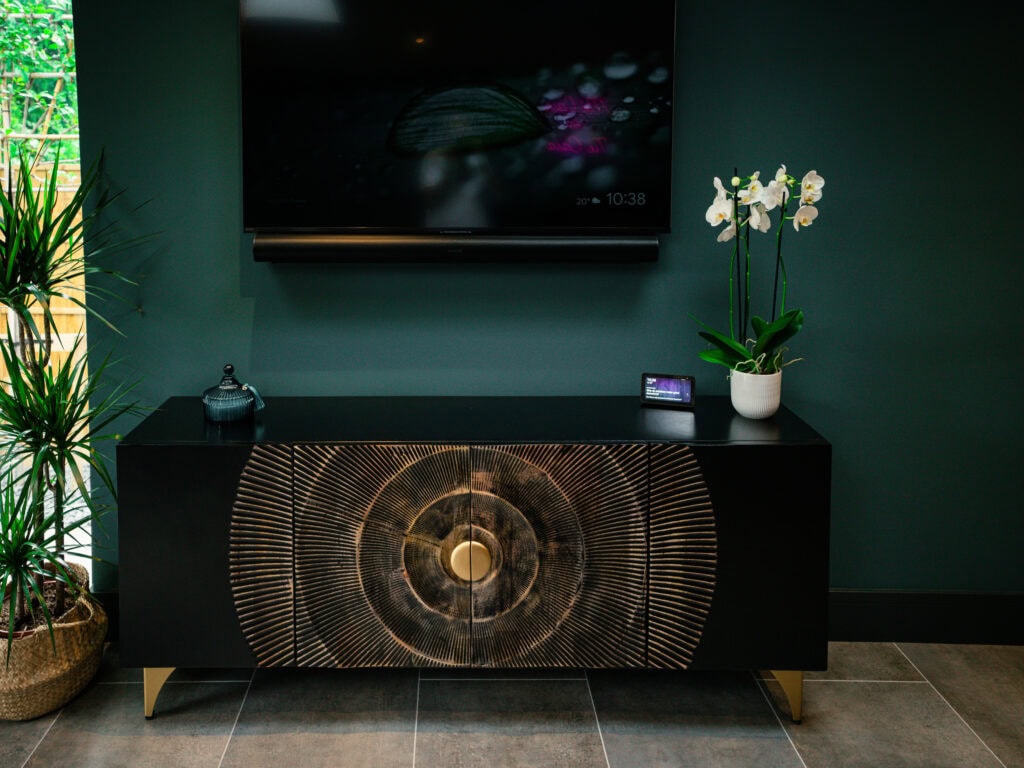
Beside a TV, the same thinking applies to the soundbar. Artcoustic offers several in standard and made-to-measure widths so the bar lines up with the screen above it. For a dedicated room, our home cinema design team would weigh the Spitfire line arrays against other cinema speakers on output, seating distance and room size.

Apartment living room with a wall-mounted TV on a wood-panelled wall opposite a suede sofa
Photo: Shixart1985, CC BY 2.0, via Wikimedia Commons
Integration

Artcoustic with Control4 and Lutron

Artcoustic's soundbar page spells out the control path. It describes the SL C-2/Stereo as built to run from an audio zone of a control system, and Control4 is one of the systems it names. The rest of the range follows the same logic, because Artcoustic's FAQ says most models are cabled and need an amplifier. The intelligence therefore lives in the rack, in the amplifier, streamer or AV processor, and the artwork on the wall plays whatever that zone sends it. Control4's driver database showed no Artcoustic entry at the time of writing, and a passive speaker has no use for one.

In a Control4 house, each pair of Artcoustic speakers becomes a zone with its own source and level, and Lutron lighting control sets the room around it. A few examples:

  • Gallery: picture lights rise on the real paintings while the speaker artworks play quiet music, so both kinds of frame look intentional.
  • TV time: switching on the television sends its sound to the soundbar and subwoofer and dims the ceiling lights, leaving the table lamps on.
  • Goodnight: one press on the hall keypad turns off every Artcoustic zone along with the lights on the ground floor.

Our guide to planning lighting scenes explains how to pick the moments worth automating, and our Control4 smart home page covers the wider system.

Already own Artcoustic?

Already own Artcoustic speakers?

Most questions from Artcoustic owners are about what surrounds the speakers rather than the speakers themselves. The amplifier may be ageing, the slim panels may sound light because no subwoofer was ever added, or the room may have been refurnished so the old levels no longer suit it. Perhaps a pair is moving to another room, or you want new artwork on the screens and are unsure which size to order. If a CPH speaker on Wi-Fi keeps dropping off, the home network is worth checking first. We can help with each of these, and with putting existing Artcoustic speakers under Control4 so they follow your lighting. If another firm put the speakers up, our takeover and maintenance service picks up from there.

Ask about your system Call 020 3397 9888

We also look after systems installed by other companies. See takeover and maintenance.

Compare

Artcoustic or invisible speakers?

Both answer the same worry, a wall dotted with grilles, in opposite ways. Invisible speakers, such as the Sonance Invisible Series, are built into the wall surface and decorated along with it, so they have to go in during building work. Artcoustic stays on the surface and turns the speaker into a picture or a block of colour, so it can join a finished room and be refreshed later by changing a screen. Choose invisible for a bare wall; choose Artcoustic when that wall was always going to hold art.

artcoustic control4
Our showroom

See and hear it before you decide

Visit our demonstration cinema and smart home showroom in Walton-on-Thames and try the technology for yourself.

“We engaged AOI for the renovation of our period property in West London. A key requirement was a discreet, high-performance cinema arrangement that would blend seamlessly with the original character of the house, and they delivered exactly that.”

F
Fraser RobsonWest London

“Fantastic service from Andy and Adrian, who installed a cinema room and full Sonos sound integration throughout my home. I would definitely recommend them! Their communication and professionalism were excellent from start to finish, and the cinema room they created was outstanding.”

C
Chris KiplingGoogle review

“We've worked with the team at Art of Integration on several high-end residential projects, where they've delivered Control4 smart home systems. From the initial design through to client handover and ongoing support, their attention to detail and level of service has been outstanding.”

A
Amanda HollisTrade partner
Questions

Artcoustic: your questions answered

Anything else, call us on 020 3397 9888.

Where are Artcoustic speakers made?

Artcoustic is a Danish company based in Copenhagen, founded in 1998 by Kim Donvig and Patricia Ljungberg. It says its speakers are hand-built in Europe and sold in more than 35 countries. In the UK it lists a training facility and showroom in Chelmsford, Essex, which is the place to see the range in person.

Can you put your own picture on Artcoustic speakers?

Yes. Artcoustic offers digitally printed front screens using an image from its online Art Gallery, where invited artists create designs for the speakers, or an image you supply. The screens attach magnetically and are interchangeable, so you can change the artwork later without replacing the speaker. Printed artwork is an extra-cost option.

Do Artcoustic speakers need an amplifier?

Most do. Artcoustic says most of its models are cabled and need a separate amplifier, with the CPH Series the exception, as it includes amplified options with Bluetooth and Wi-Fi. Because the speakers are highly sensitive, they need less power than many for cinema volume, but the amplifier must still match their impedance and power rating.

How do Artcoustic speakers connect to a Control4 system?

Through an amplifier or AV processor in the equipment rack. Artcoustic says most of its speakers are cabled and need an amplifier, and describes its SL C-2/Stereo soundbar as built to run from a control-system audio zone, naming Control4. Control4 then decides what that zone plays and how loudly. Passive speakers need no driver, and Control4's database listed no Artcoustic driver at the time of writing.

Can an Artcoustic soundbar be made to fit my TV?

Usually, yes. The SL Multi Soundbar comes in six standard sizes for flat screens plus bespoke widths, and the CPH Stereo Soundbar uses replaceable baffles to suit the screen. Some Artcoustic soundbars work as a combined left, centre and right speaker; others act as a centre channel only, with separate speakers either side.

Can Artcoustic speakers be used outside?

A few models can. The SL Evolve 1 IP and SL Evolve 1 Array IP are IP66-rated, with sealed solid-surface cabinets, and fix to an outdoor bracket or a ground spike in a lawn or bed. Artcoustic also lists an IP66 subwoofer, the Sub Ci4-5 MK II IP, for outdoor and wet-room use.

Get in touch

Talk to us about Artcoustic

Planning a new room, or need help with a Artcoustic system you already have? Tell us a little about it and a designer will come back to you.

  1. We call you backA quick conversation about your home, the room and your timings.
  2. Design consultationAt your home or in our Walton-on-Thames showroom, where you can see and hear the technology.
  3. Design and proposalA tailored design, with 3D visuals before you commit.

Request a free consultation

It takes less than a minute.

We will get back to you as soon as possible. We use your details to reply to your enquiry and keep them as described in our Privacy Policy.

Artcoustic is a trademark of its owner. This page describes how we can integrate and support these products. Project photos are our own. Other images: Photo: Linsy Raaffels, CC BY-SA 4.0, via Wikimedia Commons; Photo: Shixart1985, CC BY 2.0, via Wikimedia Commons.